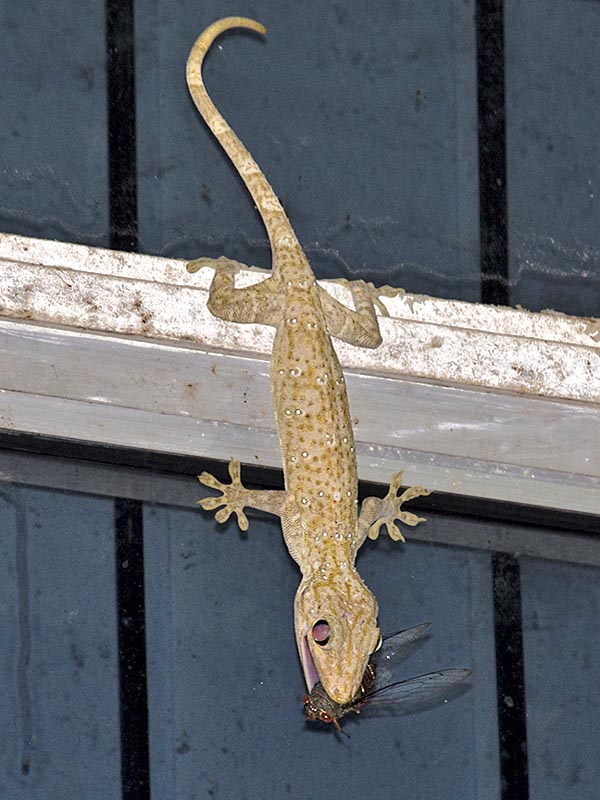
Fig 1
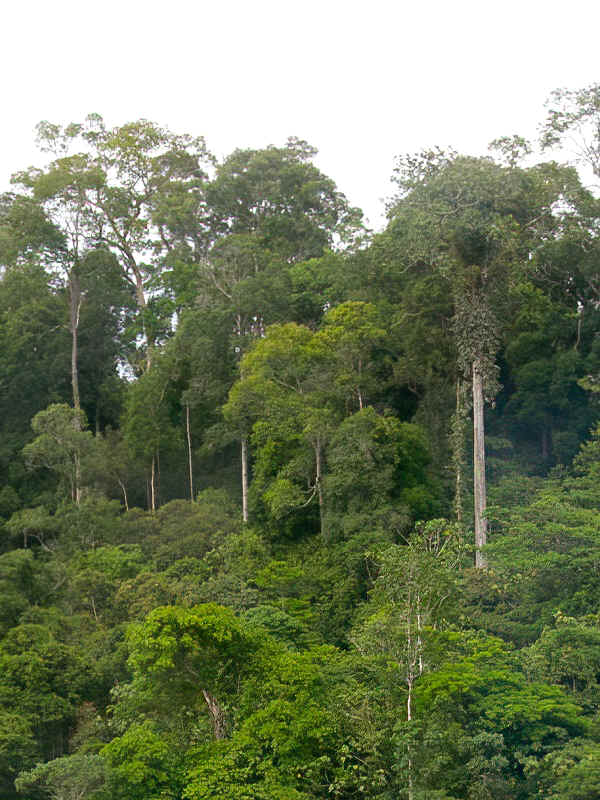
Fig 2
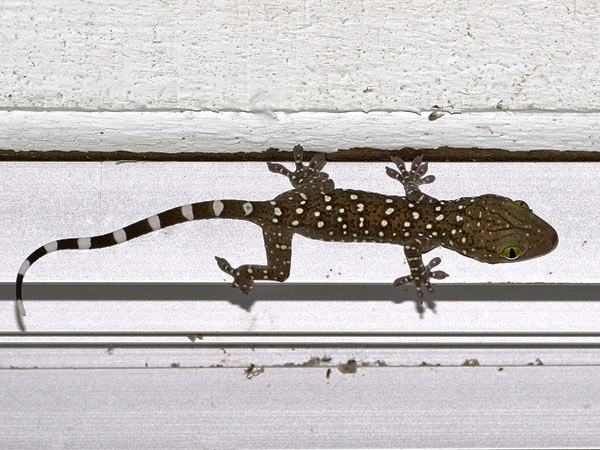
Fig 3
|
Family : GEKKONIDAE
Species : Gekko albofasciolatus
Size (snout to vent) : up to 16.5 cm
(Source : Grismer et al, 2022)
Size (total length) : up to estimated ~ 33 cm
Gekko albofasciolatus
(White-banded Forest Gecko, White-banded Narrow-disked Gecko) is a large gekkonid which inhabits parts of
Borneo, and the Natuna Islands which lie to the northwest of Borneo in the
South China Sea (see Figure 1 distribution map in Grismer et al,
2022).
The species is part of the Gekko smithii
complex, and was revalidated as a separate species in 2022 (Grismer et al,
2022), however the precise limits to its distribution within Borneo appear
uncertain; populations east of the Iran Mountains in Borneo may represent
another species. Refer to detailed discussion on this matter in the latter
publication.
Two examples from Lambir Hills, Sarawak, are shown here, one adult and one
sub-adult. Both were feeding on insects, including a cicada, attracted to
lights at the Lambir Hills visitor centre, at the edge of primary lowland
forest.
The large adult (Figure 1) is buffy brown, patterned with small,
yellowish-brown patches and lines, and small white spots. The Y-shaped
marking on the head is visible in both examples; this feature is also
present in Gekko smithii on the
Asian mainland. The tail is banded. Camera flash has affected the typical
green iris in this image.
The sub-adult or juvenile (Figure 3) is dark brown patterned with white
blotches, and the tail is strongly banded. The green colour of the iris has
not been afffected by camera flash in this image.
A wide variety of colouration and patterning are illustrated in Grismer et
al's paper.
Fig 1 : Adult example from Lambir Hills, Sarawak, Borneo, feeding on a large
cicada attracted to the lights of a hut near the forest edge.
Fig 2 : Tall lowland forest at Lambir Hills, Sarawak.
Fig 3 : Sub-adult or juvenile from Lambir Hills, Sarawak, Borneo found on a
hut at the forest edge.
References :
Grismer LL, del Pinto L, Quah ESH, Anuar S, Cota M, McGuire JA, Iskandar DT,
Wood PL Jr, Grismer JL 2022. Phylogenetic and multivariate analyses of Gekko smithii
Gray, 1842 recover a new species from Peninsular Malaysia and support the
resurrection of G. albomaculatus
(Giebel, 1861) from Sumatra. Vertebrate Zoology 72 47–80.
|