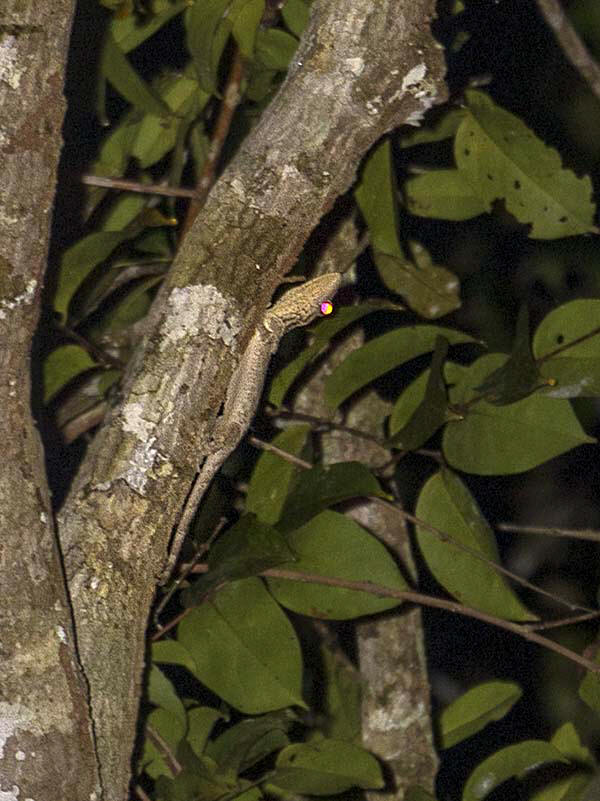
Fig 1
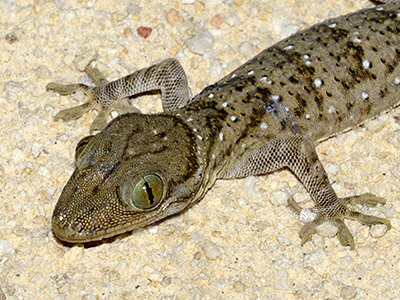
Fig 2
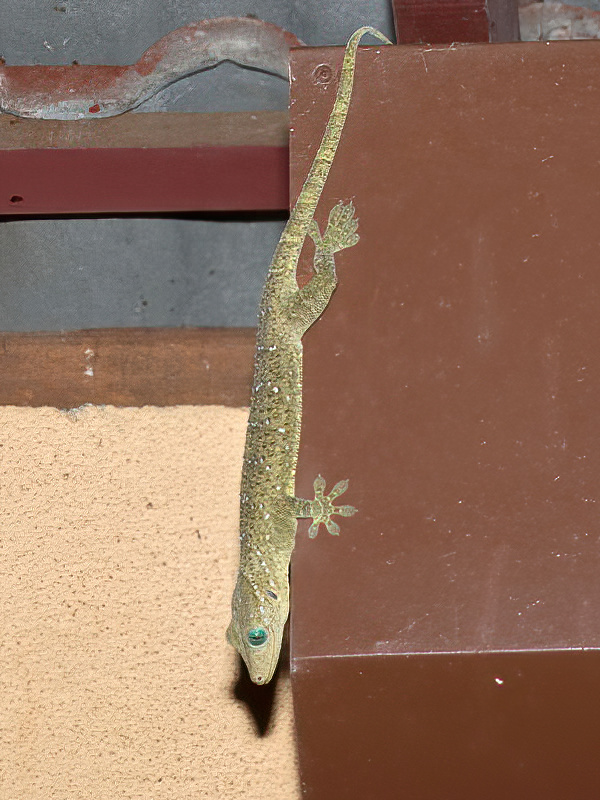
Fig 3
|
Family : GEKKONIDAE
Species : Gekko hulk
Size (snout to vent) : up to 16.1 cm
(Source : Grismer et al, 2022)
Size (total length) : up to 30 cm
Play call
►
Gekko hulk (Green-eyed Forest Gecko) inhabits primary forest and swamp forest from the lowlands
to around 1000 metres elevation. It is mainly arboreal and typically
occurs high in the canopy, where it often clings to tree trunks face-down.
In Peninsular Malaysia it also occurs on rocky islands, where it takes
refuge amongst large boulders (Grismer, 2011).
It also shelters beneath
the roofs of huts or cabins at the forest edge.
This huge gecko is more often heard than seen; its distinctive call can be
heard both day and night. The call is similar in tone to that of Gekko
gecko (Tokay Gecko), and typically comprises 3 to 7 short croaks,
followed by a final croak which is lower in pitch and longer in duration.
In the field Gekko hulk can be identified by its large size,
overall brown colour, faint or dark bands across its dorsum and tail, and bands of
white spots. Its head is large, and its eyes are green with vertical pupils.
The body bears numerous tubercles.
There is, however, some geographic variation in colour and patterning.
Gekko hulk occurs in eastern, central and southern Peninsular
Malaysia, including some offshore islands.
In Singapore it appears to have become locally extinct; its loud call, which
was once easily heard in remnant areas of primary lowland forest, was last
documented in 1997 (Teo & Rajathurai, 1997). It was not recorded during a comprehensive
survey of Bukit Timah Nature Reserve in 2015-2016, formerly a core habitat
for the species (Teo & Thomas, 2019).
Fig 1 : Example clinging to the underside of a branch at night,
high in the canopy at Panti Forest, Johor, Peninsular Malaysia.
Fig 2 : This example was found navigating across bare, denuded ground in
Panti Forest, Johor, Peninsular Malaysia.
Fig 3 : Gekko hulk from Merapoh, Pahang, central Peninsular Malaysia taking
shelter in a rest hut.
References :
Grismer, L. L. (2011). Lizards of Peninsular Malaysia, Singapore, and
their Adjacent Archipelagos. Their Description, Distribution, and
Natural History. Edition Chimaira, Frankfurt am Main. 728 pp.
Grismer LL, del Pinto L, Quah ESH, Anuar S, Cota M, McGuire JA, Iskandar
DT, Wood PL Jr, Grismer JL 2022. Phylogenetic and multivariate analyses
of Gekko smithii Gray, 1842 recover a new species from Peninsular
Malaysia and support the resurrection of G. albomaculatus
(Giebel, 1861) from Sumatra. Vertebrate Zoology 72 47–80.
Teo, R. C. H. & Rajathurai, S. (1997). Mammals, Reptiles and
Amphibians in the Nature Reserves of Singapore –Diversity, Abundance
and Distribution. The Gardens’ Bulletin Singapore, 49, 353-425.
Teo, R. C. H., & Thomas, N. J. (2019). Updated inventory of amphibians,
reptiles and mammals of the Bukit Timah Nature Reserve, Singapore. Gardens
Bulletin, Singapore, 71(Suppl 1), 145-183.
|