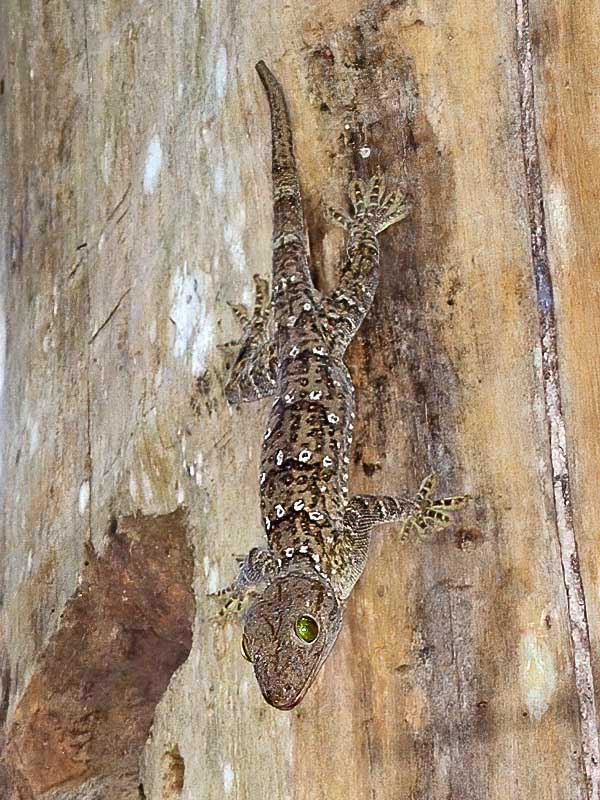
Fig 1
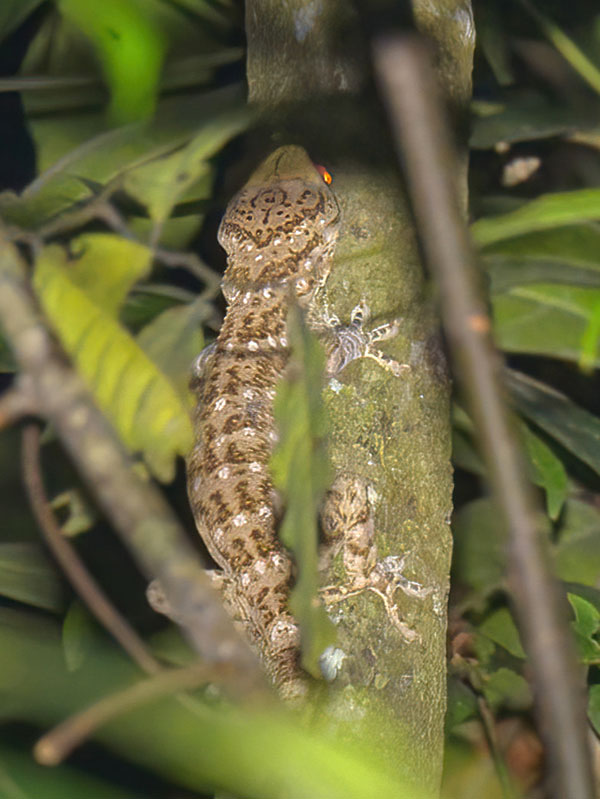
Fig 2
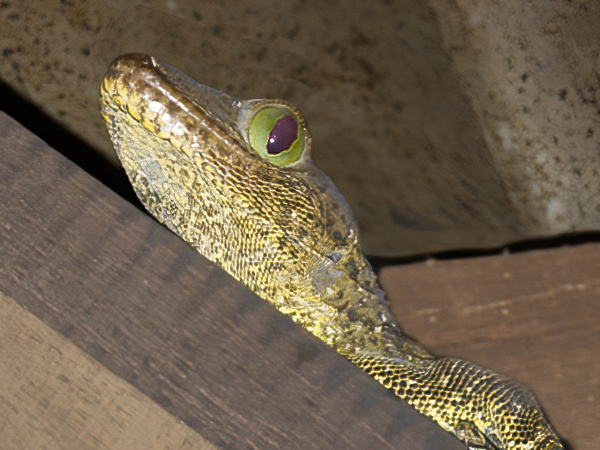
Fig 3
|
Family : GEKKONIDAE
Species : Gekko smithii
Size (snout to vent) : up to 19.1 cm
(Source : Grismer et al, 2022)
Size (total length) : up to estimated ~ 38 cm
Gekko smithii (Large Forest Gecko) inhabits primary
and good secondary forest from the lowlands
to around 1000 metres elevation.
This huge gecko is strongly arboreal and typically
occurs high in the forest canopy. It is active at night when it searches for insect prey. By day it
typically remains hidden in a favoured treehole or beneath
the roofs of huts or cabins at the forest edge, but it may sometimes be
observed on tree trunks facing head downwards near the entrance to its hiding place.
Gekko smithii is more often heard than seen; its distinctive call
comprises a series of duck-like 'quacks' followed by a lower-frequency
rasping tone. The call is similar that of Gekko
hulk (Green-eyed Forest Gecko), and it may be heard calling by
both day and night.
In the field Gekko smithii can be identified by its large size,
overall brown colour, dark bands across its dorsum and tail, and rows of
white spots.
There is some geographic variation in colour and patterning, however. Its head is large, and its eyes are green with vertical pupils.
Its body bears numerous tubercles.
Gekko smithii occurs in northern and northwestern Peninsular
Malaysia (including the islands of Langkawi, Penang and Pangkor) and parts
of southern Thailand.
The closely-related Gekko hulk was separated from Gekko smithii
by Grismer et al (2022); Gekko hulk occurs in Peninsular Malaysia to
the south and east of Gekko smithii.
Fig 1 : Fully-grown adult clinging to the trunk of a dead tree by day.
Its favouredt treehole is at bottom left. Seen at South Belum Forest Reserve, northern Peninsular Malaysia.
Fig 2 : Example from Ulu Kinta, Perak, northern Peninsular Malaysia in dense,
cluttered vegetation near the forest floor.
Fig 3 : Example from Ulu Kinta, Perak, northern Peninsular Malaysia inside a
forest 'pondok' (an open-sided rest shelter).
References :
Grismer, L. L., 2011. Lizards of Peninsular Malaysia, Singapore and their
Adjacent Archipelagos. Edition Chimaira. 728 pp.
Grismer LL, del Pinto L, Quah
ESH, Anuar S, Cota M, McGuire JA, Iskandar DT, Wood PL Jr, Grismer JL
2022. Phylogenetic and multivariate analyses of Gekko smithii
Gray, 1842 recover a new species from Peninsular Malaysia and support
the resurrection of G. albomaculatus (Giebel, 1861) from Sumatra.
Vertebrate Zoology 72 47–80.
|