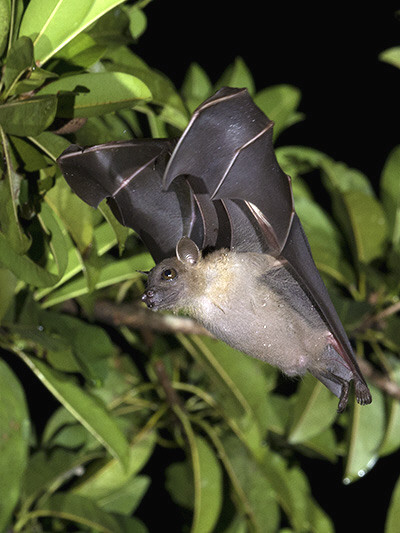
Fig 1
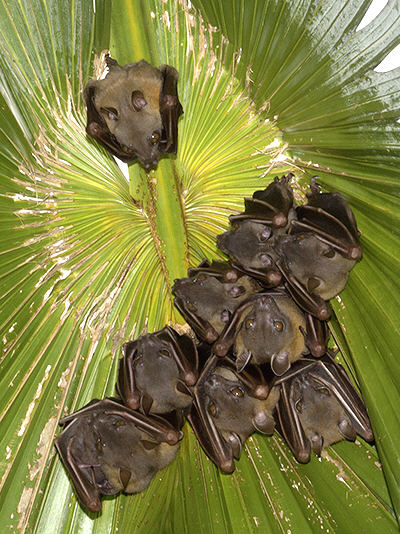
Fig 2
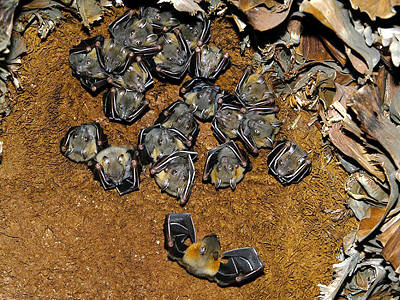
Fig 3
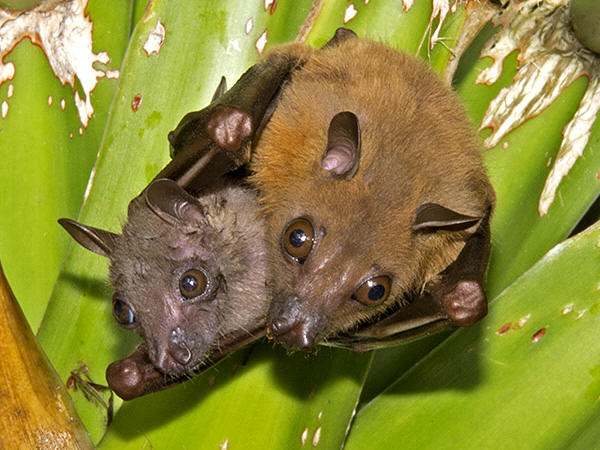
Fig 4
|
Order : CHIROPTERA
Family : Pteropodidae
Species : Cynopterus brachyotis
Forearm Length : 59-70 mm
Weight : 32- 42 grams
(Francis, 2019)
Cynopterus brachyotis
(Sunda Short-nosed Fruit Bat, Lesser Dog-faced Fruit Bat, Common Fruit Bat) is
wide-ranging and can be locally common in areas where it occurs.
The genus Cynopterus can be identified by their white-edged ears,
white wing bones and by the dog-like shape of the skull. Cynopterus brachyotis
typically has yellowish-brown fur around the neck, tinged reddish in males.
Cynopterus brachyotis
is clearly a species complex, and future studies will likely split it into
separate species.
A likely candidate to be treated as a separate species is the Forest
Short-nosed Fruit Bat (Cynopterus
cf. brachyotis); this smaller and rarer bat inhabits mature, primary forest
where the Sunda Short-nosed Fruit Bat is rarely found (Francis, 2019).
Cynopterus brachyotis occurs in a range of relatively open habitats
including secondary forest, mangrove, cultivated areas, and parks and
gardens. They do not usually occur in mature primary forest.
By day these bats roost in the shade of epiphytic ferns,
amongst leaf clutter, under palm fronds, near cave entrances or under
man-made structures.
These bats mainly feed on the pulp of soft fruits and figs
which they select from a tree at dusk, and then transport to a favoured,
quiet feeding area, for example under the roof of a forest hut or the eaves
of a house.
This species complex ranges from parts of India, Bangladesh and Sri Lanka,
to much of mainland Southeast Asia, western Indonesia and the
Philippines.
Fig 1 : This bat was attracted to ripe fruits of the sapodilla or chiku tree (Manilkara zapota)
in Singapore.
Fig 2 : Adult male with harem of 8 females beneath the frond of a palm tree
in Singapore:
the veins of the leaf have been chewed to make the leaf collapse and form a
protective, umbrella-like tent.
Fig 3 : Adult male with his harem of 20 females in the shelter of a
Bird's Nest Fern Asplenium nidus, Singapore.
Fig 4 : A mother shields her almost fully-grown pup in the grounds of a
condominium in Singapore.
References :
Francis, C.M. 2019. A Field Guide to the Mammals of South-east Asia. Second
Edition. New Holland. 416 pp.
|