Fig 2
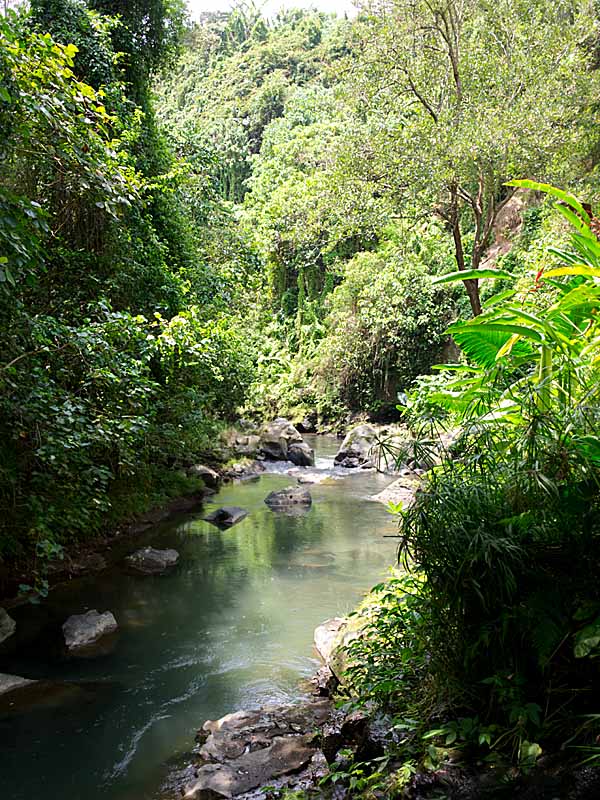
Fig 2
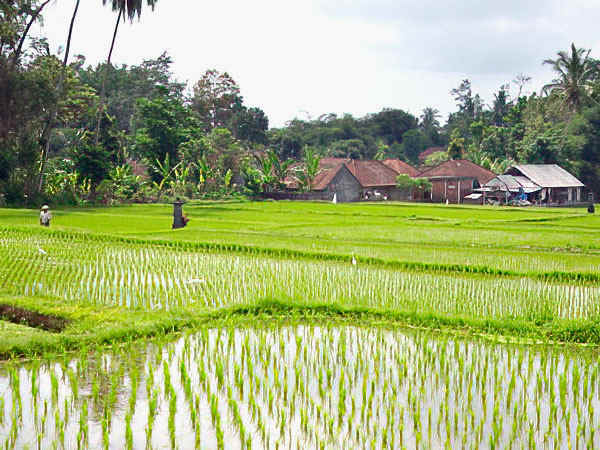
Fig 3
|
Family : RANIDAE
Species : Hylarana chalconata
Size (snout to vent) :
Females to 73 mm, males to 50 mm
(Inger et al, 2009)
Hylarana chalconata
or Chalcorana chalconata (Schlegel's Frog) is endemic to islands in
the west of Indonesia; the species was first described by Schlegel in 1837,
as Hyla chalconotus, from a specimen acquired in Java.
In 2009 a detailed study confirmed its range to include Java and parts of
South Sumatra (Inger at al, 2009). Although Bali is not mentioned in the
latter paper, a ranid of similar appearance in Bali is widely accepted to be
Hylarana chalconata.
The eastern limit of this species is thus probably the Wallace Line, a
significant biogeographic boundary which follows the
Lombok Strait separating Bali from Lombok.
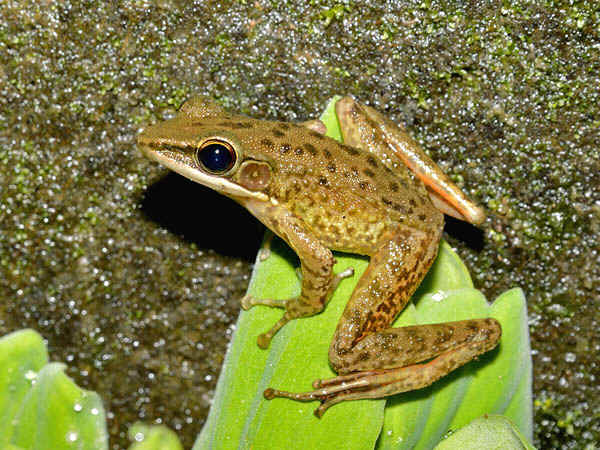
The head, body and legs of Hylarana chalconata show the typical
morphology of 'true frogs', or ranids. Its
colour can be variable, but it is typically brownish or yellowish, and
sometimes greenish.
Most forms have dark spots on the dorsum. The lips are white, and the
tympanum is clearly visible. The dorso-lateral fold is narrow.
This species is adaptable to a wide range of aquatic habitats from lowlands
to around 1500 metres elevation. Such habitats include forest streams, ponds
and rice paddies.
The example shown here (Figure 1) was found in a man-made pond in south-central Bali,
at an elevation of 250 metres; there does not appear to be a humeral gland,
so this is probably a female.
Bali's aquatic habitats include extensive
rice paddies, streams and small rivers that cascade down from nearby
volcanos (Figures 2 and 3), as well as urban drainage ditches in the south. Java, to the west
of Bali, possesses
similar, albeit more extensive, habitats which support good numbers of Hylarana chalconata.
Fig 1 : Example from near Ubud, in south-central Bali at an elevation of 250
metres. This is probably a female as the male humeral gland is not visible.
Fig 2 : A typical fast-flowing stream in rural Bali incised into the flanks
of one of the island's volcanos. Hylarana chalconata can be found in
quieter pools at the edge of such streams.
Fig 3 : Typical Balinese rice paddies; Hylarana chalconata can be
found in drainage ditches at the margins of these fields.
References and links :
Inger, Robert F.; Stuart, Bryan L. & Iskandar, Djoko T. (January 2009).
"Systematics of a widespread Southeast Asian frog, Rana chalconota
(Amphibia: Anura: Ranidae)". Zoological Journal of the Linnean Society.
155 (1): 123–147.
Wikipedia
- Wallace Line
|