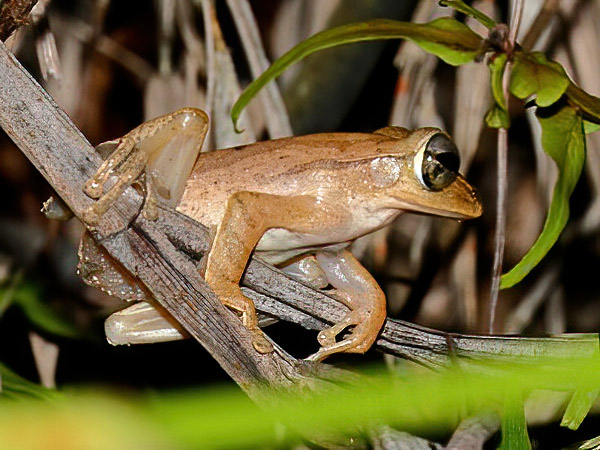
Fig 1
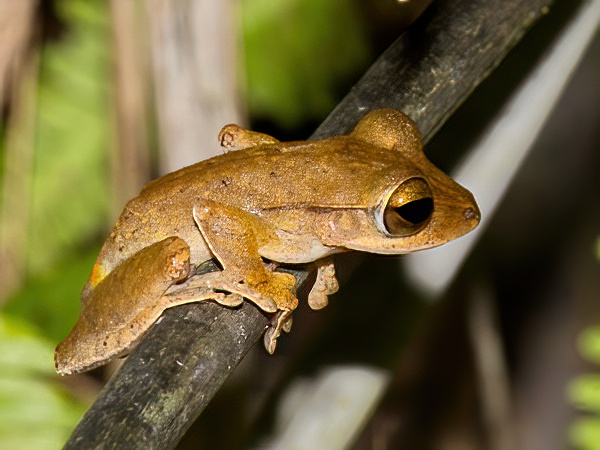
Fig 2
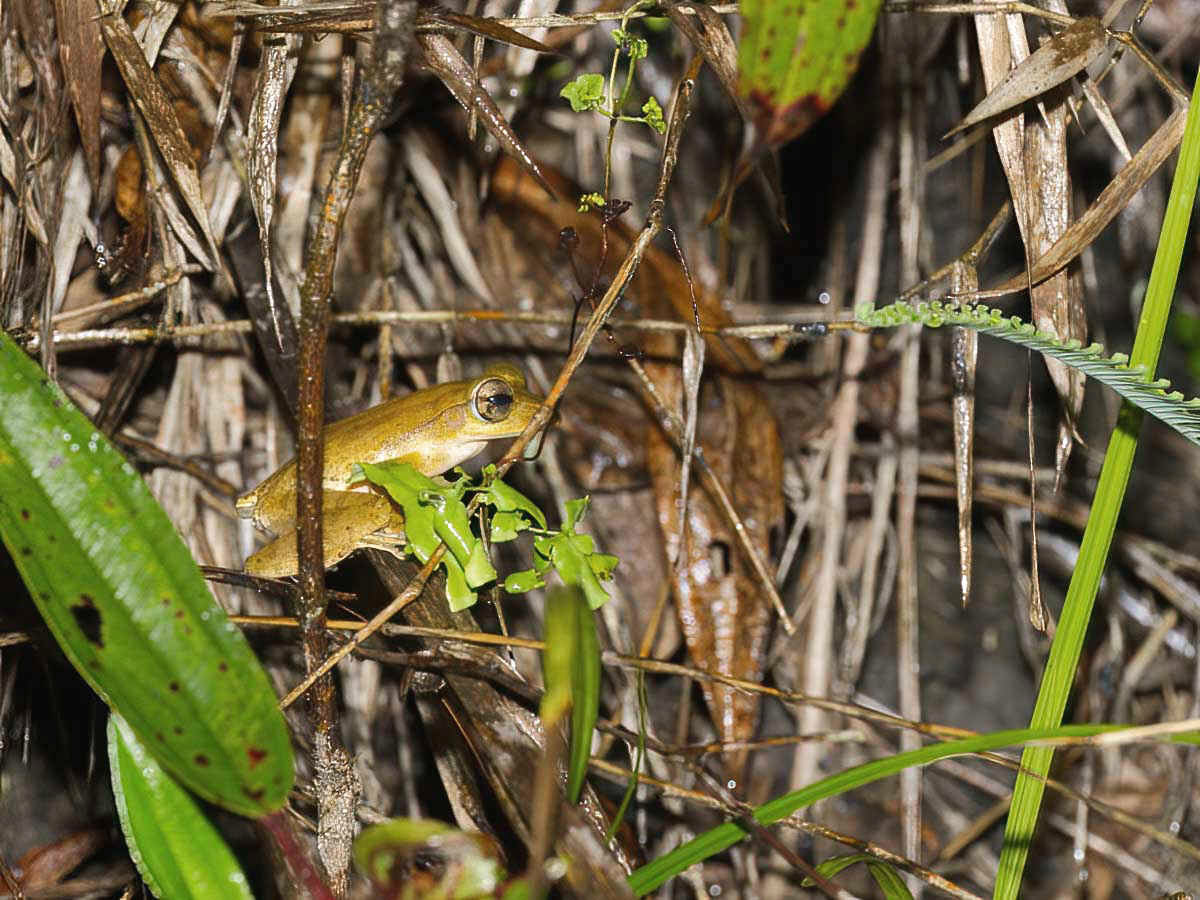
Fig 3
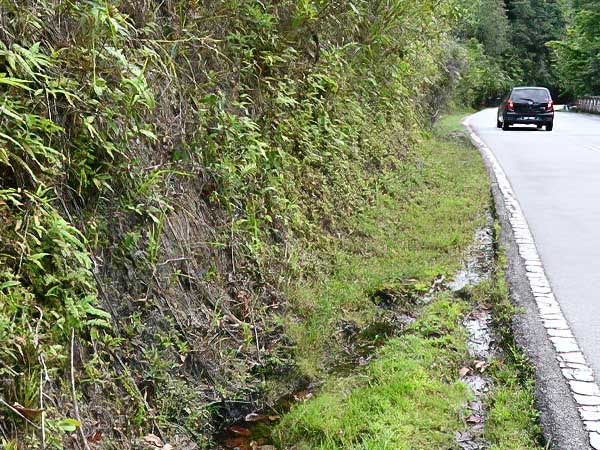
Fig 4
|
Family : RHACOPHORIDAE
Species : Polypedates discantus
Size (snout to vent) :
Female to 67 mm, Male to 57 mm
(Rujiwaran et al, 2013).
Play calls
►
[composite audio of two of the call types]
Polypedates discantus
(Malayan Slender Tree Frog) was described as a new species in 2013 from
specimens taken in Songkhla province, southern Thailand (Rujirawan et al,
2013). Formerly it was treated as a form of Polypedates
leucomystax (Four-lined Tree Frog).
The range of this somewhat elusive frog appears to be limited to parts of
southern Thailand and Peninsular Malaysia; it has yet to be found in
Singapore, despite searches by enthusiasts and researchers.
When present in the same general area, P. discantus often frequents
the same breeding sites as P. leucomystax, a common and highly
adaptable species.
In the field, the easiest way to distinguish between P. discantus and
P.
leucomystax is by their calls. P. leucomystax emits a loud single duck-like 'quack' call. P. discantus however has a range of quieter
calls including one-note, two-note and three-note clicking sounds, as well
as a 'staccato' call of around 10 or more separate pulses (Rujirawan et al, 2013).
Close observation of the tibio-tarsal articulation (i.e. near the 'ankle')
of P. discantus will reveal a raised tubercle, which P.
leucomystax lacks (Rujirawan et al, 2013).
Documented here is a grassy, roadside pool, found at an elevation of 320
metres in the state of Selangor,
Peninsular Malaysia; this small pond is partly formed by the wheel ruts of passing
vehicles.
Around 10 or so frogs were calling after dusk from the vegetated embankment
next to this pool on two successive nights, comprising both P. discantus
and P. leucomystax in roughly equal numbers.
Three examples of P. discantus
are shown here; their colour ranges from yellowish to light brown, and their
patterning includes faint dorsolateral stripes (Figure 1) and a plain dorsum
with dark spots (Figure 2). The frog in Figure 1 clearly
possesses the raised tubercle on its tibio-tarsal articulation.
The frog in Figure 1 was heard (and seen) to emit a 2-note call. Also
recorded at this site were examples of the 'staccato' call.
It was noted that P. discantus kept well hidden amongst tangled
vegetation, unlike P. leucomystax which was more bold in its habits
and would often perch on exposed twigs.
A search was made for bubble nests and larger, female frogs of both P.
discantus and P. leucomystax but none were present. A search for
tadpoles found a single tadpole of P.
leucomystax. No
tadpoles of P. discantus were found (tadpoles of this species do not
appear to have yet been formally described).
Other frogs at this degraded site included Phrynoidis asper
(River Toad), and Hylarana (Abavorana) luctuosa
(Mahogany Frog); the latter was heard calling from the embankment, and three
tadpoles were found of this ranid.
Figs 1 to 3 : Examples from highly degraded forest in Selangor,
Peninsular Malaysia (at an elevation of 320 metres); the frogs were calling
from perches above a shallow roadside pool.
Fig 4 : Microhabitat of the frogs in Figures 1 to 3 - a steep, vegetated
embankment next to a shallow, grassy, roadside pool, partly formed by the wheel ruts of
passing vehicles.
Acknowledgments : Thanks to Wayne Spencer for helping locate Polypedates
discantus and for the audio recordings. Thanks to Law Ing Sind for some
useful discussion.
References :
Rujirawan, A., Stuart, B. L., & Aowphol, A. (2013). A new tree frog in
the genus Polypedates (Anura: Rhacophoridae) from southern Thailand.
Zootaxa, 3702(6), 545-565.
|