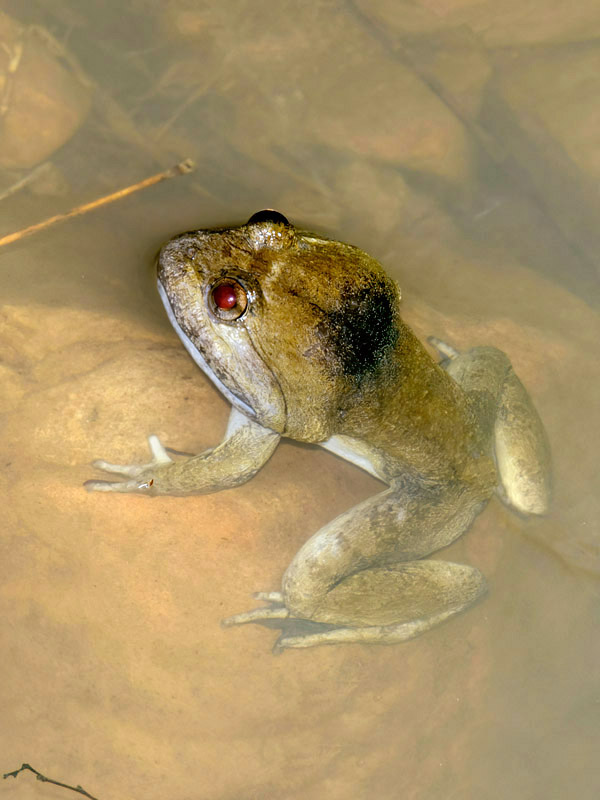
Fig 1
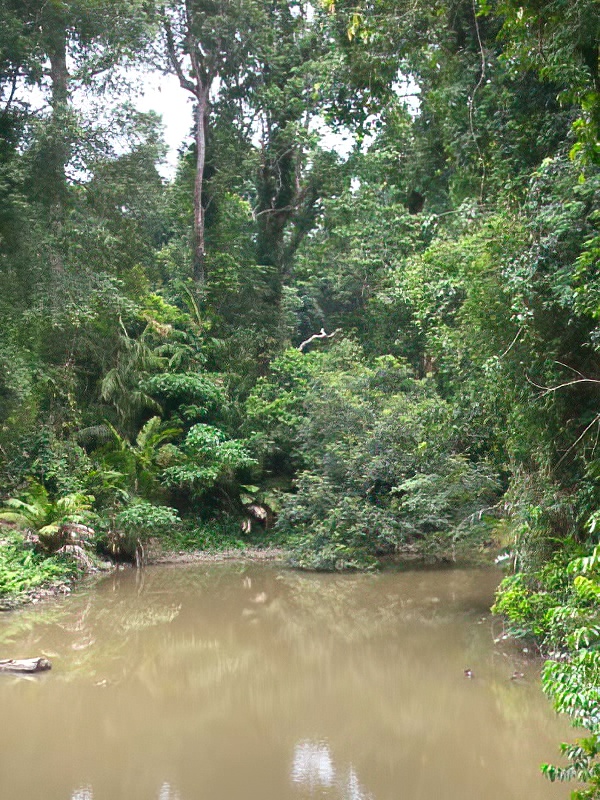
Fig 2
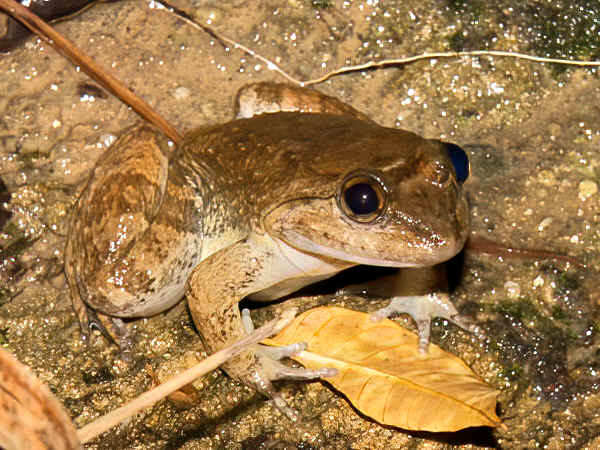
Fig 3
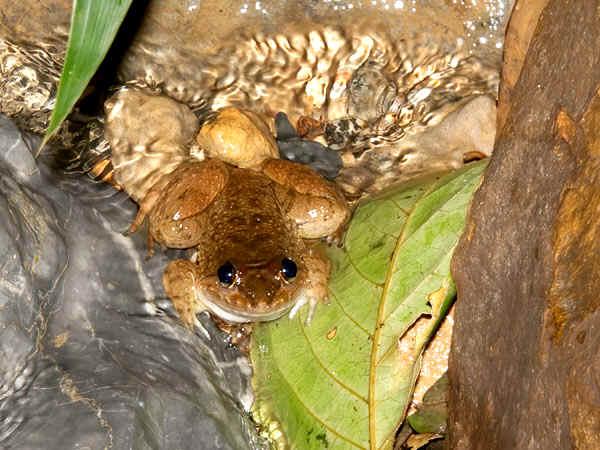
Fig 4
|
Family : DICROGLOSSIDAE
Species : Limnonectes megastomias
Size (snout to vent) :
Females to 86 mm, males to 124 mm
(McLeod, 2008)
Limnonectes
megastomias (Big-mouthed Fanged Frog, Khorat Big-mouthed Frog) was
formerly treated as a form of Limnonectes kuhlii but is now widely
recognised as a separate species within the L. kuhlii
complex (McLeod, 2008).
In terms of genetics, Limnonectes megastomias is considered to have
more than 18% 'sequence divergence' from true L. kuhlii which are smaller, have different relative finger
lengths, and only occur on the island of Java (McLeod, 2008).
Limnonectes
megastomias is endemic to eastern Thailand; in his study McLeod (2008) includes
specimens from Loei, Sa Kaew and Nakhon-Ratchasima provinces. The latter
province includes most of the land area of Khao Yai National Park.
This is primarily a forest stream-dwelling frog, which ranges from lowlands to 1460
metres elevation. Preferred streams have a sandy or silty substrate, with
accumulated leaf litter under which to hide. They predate upon insects, other
frogs, and also small birds (McLeod, 2008).
Male and female Limnonectes
megastomias are sexually dimorphic. Males have thickened and elongated
odontoid processes or 'fangs' on the lower jaw (such 'fangs' are a defining feature
of frogs in the family Dicroglossidae). In comparison to other species in the
genus, Limnonectes megastomias species is large-bodied, and males
have a greatly enlarged head compared to females (up to 56% of
snout-vent-length in males, compared to 45% in females) (McLeod, 2008).
McLeod described the (male) holotype as follows: "Dorsum olive-brown with dark brown
blotch over shoulders and indistinct, dark transverse bars on upper surface
of hind limbs; side of head and lateral surfaces of body yellowish brown;
chin brownish white; belly white with brown vermiform markings; dark brown
bar between eyes bordered by thin yellowish-brown bars; lower half of iris
gold, upper half brown, separated by dark brown horizontal band; nuptial pad
white."
The enlarged head and mouth in males appears to be used in combat with other
males; some specimens studied by McLeod had "missing digits and limbs,
fresh bite marks, and scars".
Hiroshi & Matsui (2002) studied large-bodied male-male agonistic combat
in a related species in the L. kuhlii complex from Taiwan (as Rana
kuhlii).
Fig 1 : Example from Khao Yai, central Thailand, at an
approximate elevation of 1000 metres.
Fig 2 : Silt laden stream after heavy rain at Khao Yai, Thailand.
Figs 3 and 4 : Probable female in a clear stream with mixed sandy/rocky
substrate at Khao Yai, Thailand.
Acknowledgments : Thanks to Ng Bee Choo for organising our visit to Khao Yai
National Park.
References :
Hiroshi, T. & Matsui, M. (2002) Male-Male Combat and Head Morphology in
a Fanged Frog (Rana kuhlii) from Taiwan. Journal of Herpetology, 36,
520–526.
McLeod, D. S. (2008). A new species of big-headed, fanged dicroglossine frog
(Genus Limnonectes) from Thailand. Zootaxa, 1807(1), 26.
|