Fig 1
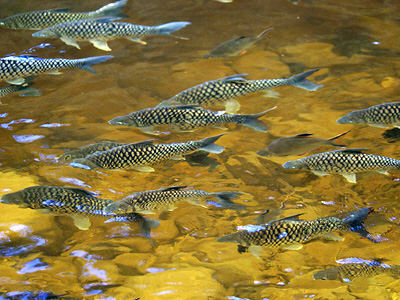
Fig 2
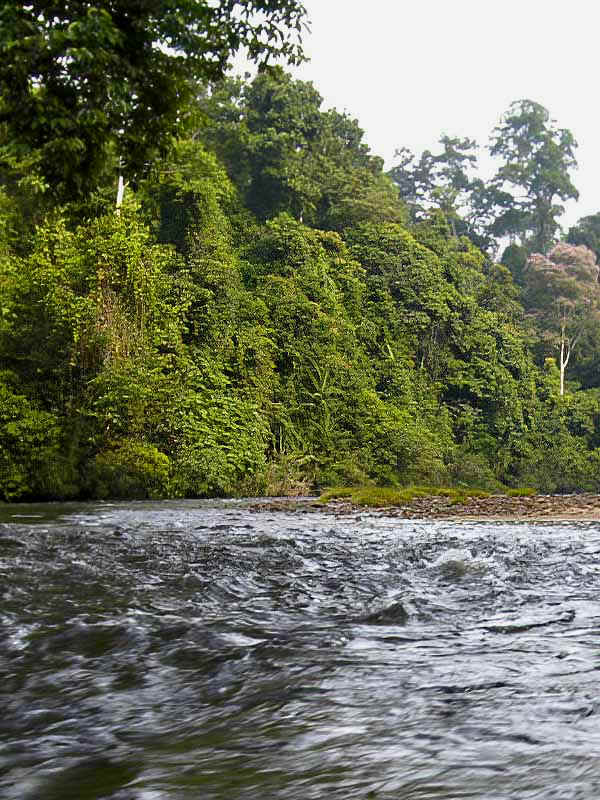
Fig 3
|
Order : Cypriniformes
Family : CYPRINIDAE
Species : Hypsibarbus wetmorei
Maximum length (including tail fin) : 46 cm
(Fishbase, 2026)
Text updated : November, 2026.
Hypsibarbus wetmorei (Lemon
Fin Barb, Golden Belly Barb) is an inhabitant of large river systems,
particularly in forested areas. It is a benthopelagic species i.e. it is
active near the riverbed (the benthic zone) as well in the open water column
(the pelagic zone).
It is known to be potamodromous i.e. it migrates within freshwater
ecosystems to find suitable feeding or breeding grounds, but never enters
brackish or saline habitats (Fishbase, 2026). Its diet comprises shrimps,
snails and forest vegetation during forest flooding events (e.g. flowers and
fruit).
Hypsibarbus wetmorei is native to the Maeklong (Thailand), lower
Mekong (Thailand, Laos, Cambodia) and the Chao Phraya (Thailand) river
basins, as well as river systems in (Peninsular) Malaysia such as the Pahang
River (Rainboth, 2012).
IUCN (Rainboth, 2012) accept two subspecies; (i) H. w. wetmorei in
the Maeklong, Mekong and Chao Phraya river systems and (ii) H. w.
tweediei in peninsular Thailand and Peninsular Malaysia.
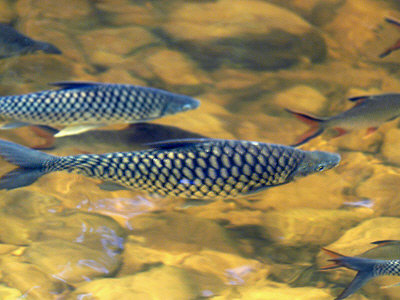
The body form of this barb is robust, and its scales are large. Its colour
is described as 'upper body reddish brown; pelvic and anal fins red to
reddish orange' (Fishbase, 2026), however the southerly subspecies, H. w.
tweediei, is silvery with yellow fins, and dark-edged scales (see
Figures 1 and 2).
This fish is locally consumed in parts of Southeast Asia; in Malaysia it is
called Kerai or Krai, and in Thailand 'Pla Tapak' or 'Pla
Krapak'.
Figs 1 and 2 : Large shoal of Hypsibarbus wetmorei tweediei
photographed in 2006 at Sungai Tahan, Peninsular Malaysia. This
location was a designated fish sanctuary, with an ongoing and successful
reintroduction program of Krai. These specimens are around 30-40 cm
in total length.
Fig 3 : Rapids on the Tahan River (Sungai Tahan), which is part of the
extensive Pahang river system in the state of Pahang, Peninsular Malaysia.
References and links :
Rainboth, W. 2012. Hypsibarbus wetmorei. The IUCN Red List of
Threatened Species 2012: e.T181331A1722850.
Fishbase
- Hypsibarbus wetmorei
|