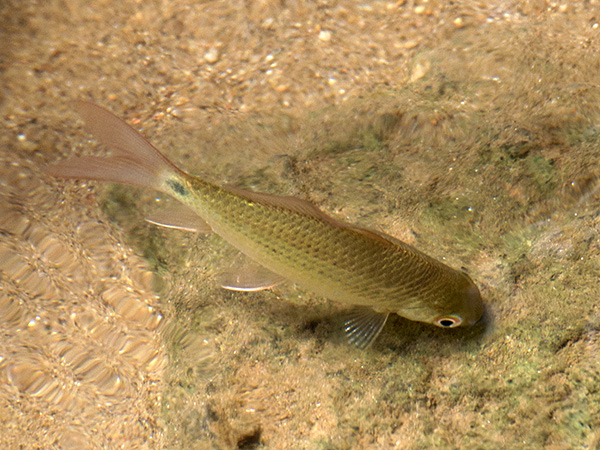
Fig 1
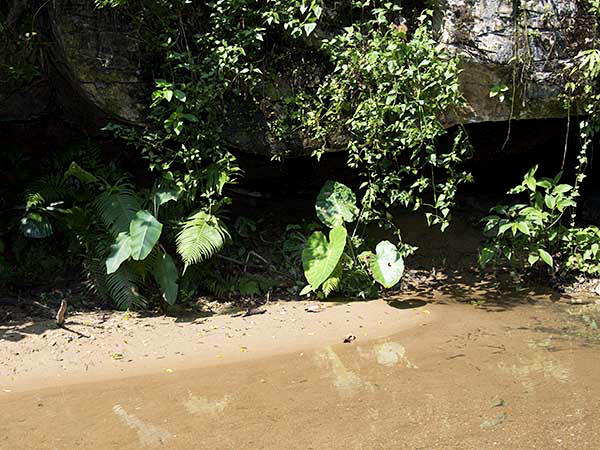
Fig 2
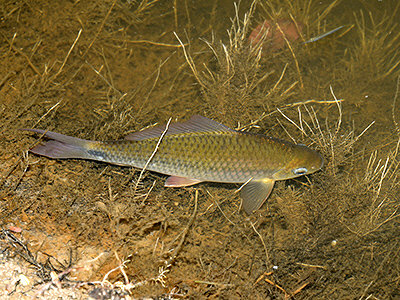
Fig 3
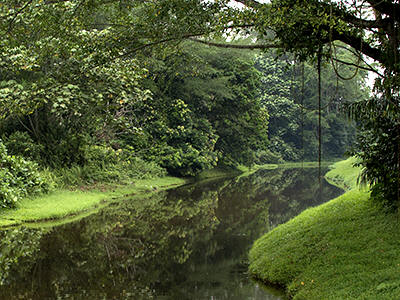
Fig 4
|
Order : Cypriniformes
Family : CYPRINIDAE
Species : Osteochilus vittatus
Maximum Length : 32 cm
Osteochilus vittatus
(Bony-lipped Barb, Hard-lipped Barb) typically inhabits slow-flowing, larger streams
and small rivers
with muddy, silty or sandy substrates.
Its body form is
laterally-compressed and rhomboidal-shaped. It is mainly silvery-yellowish in colour,
but sometimes greenish or brownish. The fins are
pinkish grading to red at the margins; the extreme margins
of the pelvic and anal fins are pale. The tail fin is deeply forked,
and the barbels are small. At the base of the tail fin is a single black
marking.
This species is mainly herbivorous,
feeding on algae and phytoplankton.
Osteochilus vittatus
occurs in many river systems of mainland Southeast Asia including major rivers in
Myanmar, Thailand, Cambodia, Laos, Vietnam and Peninsular Malaysia. It is also recorded from
the islands of Sumatra, Java and Borneo. In Singapore it is considered an introduced
species.
In the Mekong River Basin of Thailand,
Laos and Cambodia it is abundant and there a maximum length of 32 cm has been
recorded.
Fig 1 : Example from Sungai Tempurung, where it exits Gua Tempurung,
Perak, Peninsular Malaysia. ("Sungai" = large stream or
river, "Gua" = cave). It appears to be feeding on algae, which forms a
typical part of its diet.
Fig 2 : Sungai Tempurung, Perak, Peninsular Malaysia.
Fig 3 : 18 cm example in slow-flowing freshwater habitat in Singapore, where
it is an introduced species.
Fig 4 : Slow-flowing, non-tidal river with muddy/silty bottom : the specimen
in Figure 3 was found in this habitat in Singapore.
References :
Fishbase - Osteochilus vittatus
|