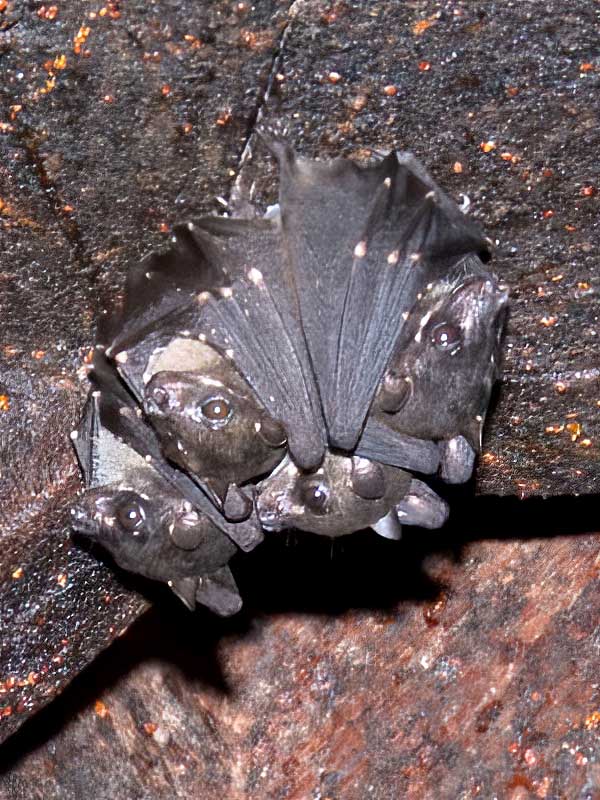
Fig 1
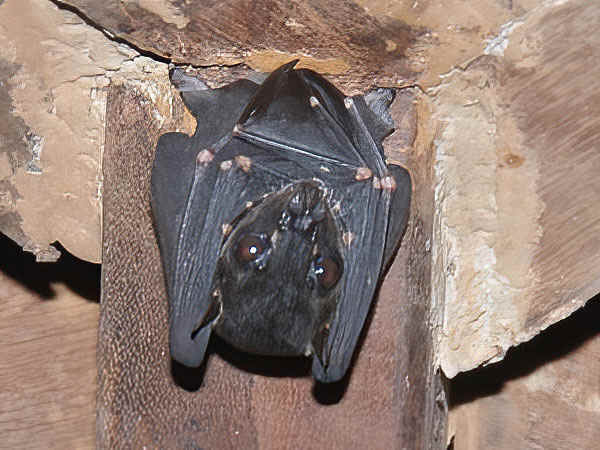
Fig 2

Fig 3
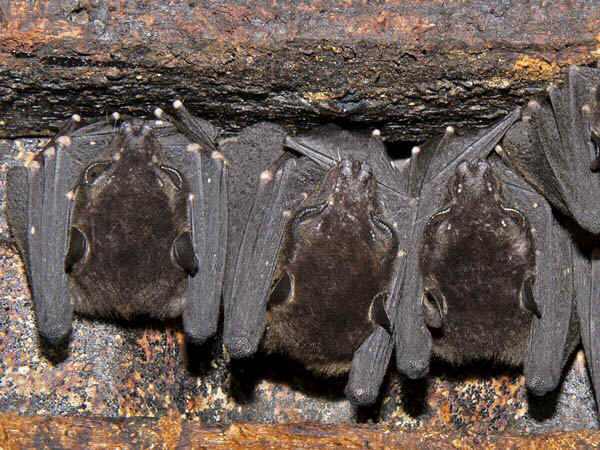
Fig 4
|
Order : CHIROPTERA
Family : Pteropodidae
Species : Balionycteris seimundi
Forearm Length : up to 4.5 cm
Weight : up to 15 grams
(Francis, 2019)
Measuring just 5 or 6 cm
from head to toe, and weighing no more than 15 grams, Balionycteris
seimundi (Malayan Spotted-winged
Fruit Bat) was formerly treated as part of Balionycteris maculata
(Khan et al, 2008). The species inhabits lowland
primary rainforest or tall secondary forest, where it feeds on forest
fruits.
In the field, this diminutive bat is easily identified by its small size, and by the pale spots which adorn
the wing and the finger joints; such spots may also occur on the face and at the
base of the ear. The dorsal fur is dark brown to dark grey, or black, and
the head has the darkest fur. The underside is pale grey, and there is no
tail. The eyes are relatively large.
This bat generally roosts in small groups, huddled together, typically beneath palm leaves, or amongst epiphytes. The absence of such plants
in recently logged forest may encourage these bats to roost under man-made
structures. They have also been recorded roosting in caves.
Balionycteris
seimundi occurs in southern Thailand, Peninsular Malaysia and the Riau Archipelago
of Indonesia. (Balionycteris maculata is now treated as restricted to
Borneo).
Curiously there are
no records from Singapore, despite this bat being present to the immediate
north in Johor (Figure 3), and to the south on Bintan Island (Figures 1 and
2).
Fig 1 : Four adult bats huddled together under a shelter in coastal forest at Bintan Island, Riau Archipelago, Indonesia.
Fig 2 : Single adult at the same roost, measuring just 6 cm from head to toe.
Fig 3 : Shelters such as this, along forest trails on Bintan Island,
are sometimes used as roosting sites by small groups of Balionycteris seimundi.
Fig 4 : Part of a roost of six from Gunung Arong, Johor, Peninsular
Malaysia.
References :
Francis, C.M. 2019. A Field Guide to the Mammals of South-east Asia. Second
Edition. Bloomsbury Publishing. 416 pp.
F.A.A. Khan, V.J. Swier, P.A. Larsen, S. Solari, K. Besar, M. Wahap, M.T.
Abdullah, S. Ellagupillay, M. Marklarin, & R.J. Baker. 2008. Using
Genetics and Morphology to Examine Species Diversity of Old World Bats:
report of a recent collection from Malaysia. Occasional Papers of the Museum
of Texas Tech University, 281:1-28.
Lekagul, B., McNeely, J., 1977. Mammals of Thailand. Association for the
Conservation of Wildlife, Thailand. 758 pp.
Payne, J., Francis, C.M., 1998. A Field Guide to the Mammals of
Borneo. The Sabah Society.
|