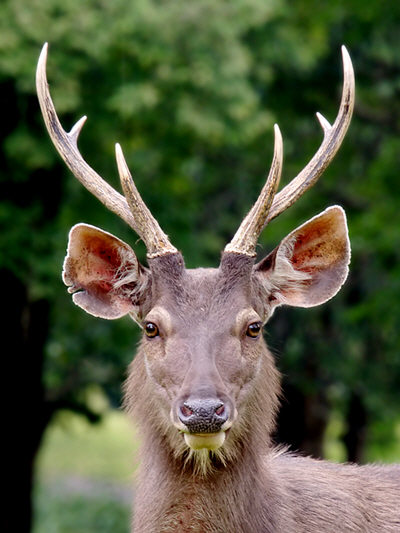
Fig 1
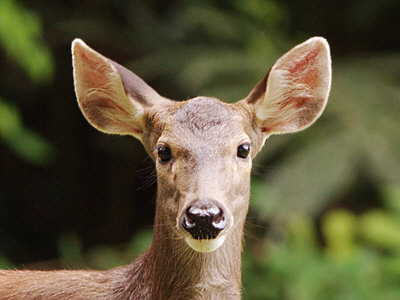
Fig 2
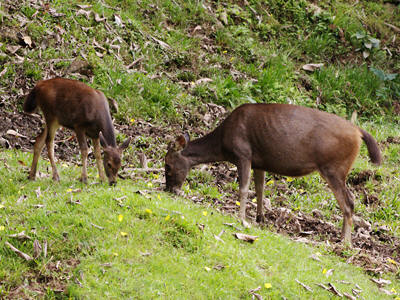
Fig 3
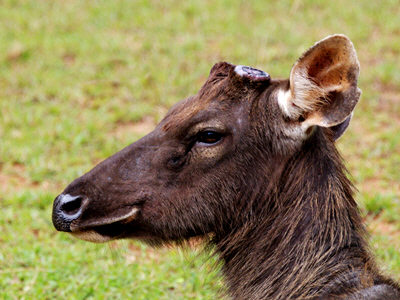
Fig 4
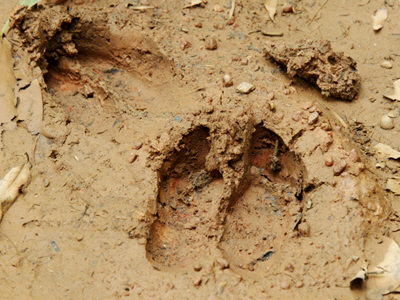
Fig 5
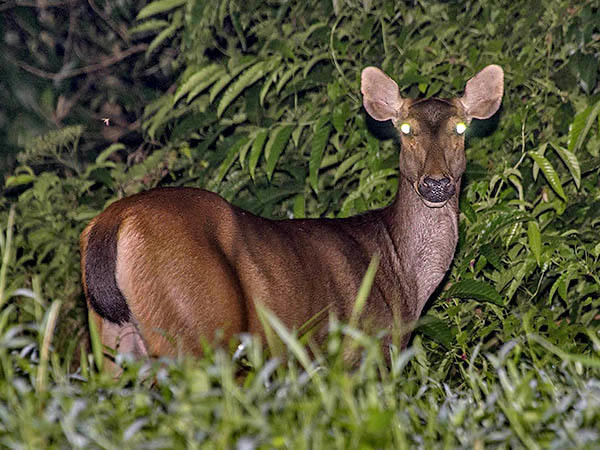
Fig 6

Fig 7
|
Order : CETARTIODACTYLA
Family : Cervidae
Species : Rusa unicolor
Shoulder Height : Males up to
1.6 metres
Tail Length : Males up to 28 cm
Weight : Males up to 260 kg
Females are considerably smaller.
The Sambar or Rusa deer
once occurred in a variety of habitats but is now confined mainly to
primary and mature secondary forests due to hunting pressure. Crepuscular
(i.e. active at morning and dusk) and nocturnal in habit, they are most
easily spotted at the forest margins where they feed on young grass shoots.
They frequent natural salt licks, particularly adult males who need minerals
to promote growth of their antlers.
Male Sambar are among the largest of Southeast Asia's deer, with a head-body
length of up to 2 metres and weighing up to 260 kg. The fur is brown to
grey-brown, the tail dark and the underside of the tail and rump area
whitish. The antlers of the male usually have three tines (points). In
addition to grass shoots they feed on vines and fallen fruits. Herds are
small with up to 4 individuals, and a single fawn is born after a gestation
period of 8 months.
The species ranges from India, Sri Lanka and Nepal through Myanmar, southern
China and Indochina, to Malaysia, Indonesia and the Philippines.
In Singapore,
Sambar were possibly hunted to extinction
in the 1940's and 1950's, however in recent years the species has somehow
re-established a small population in the country's central forests.
Fig 1 : Impressive looking male with large
antlers. Khao Yai National Park, Thailand.
Fig 2 : Female from Danum Valley, Sabah, Borneo.
Fig 3 : A mother and her calf feeding on lush grass. Danum Valley,
Sabah, Borneo.
Fig 4 : This male has recently shed his antlers : this is a natural
event which occurs every few years. Khao Yai National Park,
Thailand.
Fig 5 : Sambar tracks at Khao Yai National Park, Thailand.
Fig 6 : Adult female in dense, forest-edge grassland in Singapore.
Fig 7 : A young buck cools off in a mud wallow created by a
Eurasian Wild Pig.
References :
Francis, C.M., 2001. Mammals of South-east Asia. New Holland.
Lekagul, B., McNeely, J., 1977. Mammals of Thailand. Association for the
Conservation of Wildlife, Thailand. 758 pp.
Payne, J., Francis, C.M., 1998. A Field Guide to the Mammals of
Borneo. The Sabah Society.
|