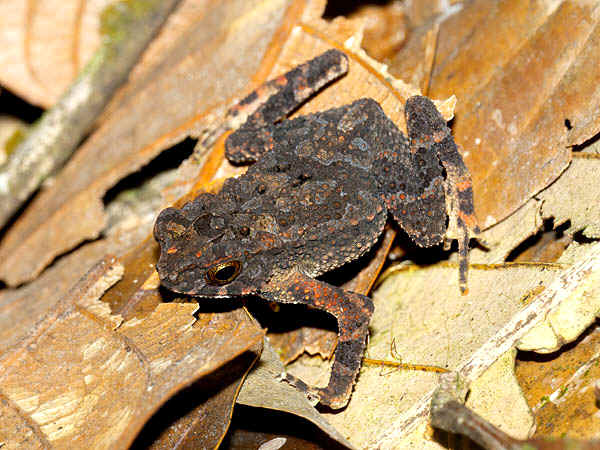
Fig 1
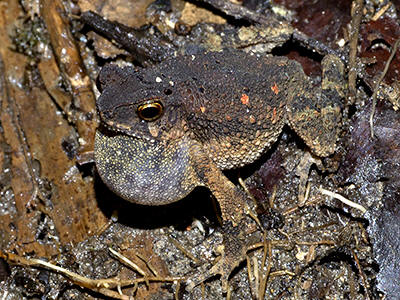
Fig 2

Fig 3
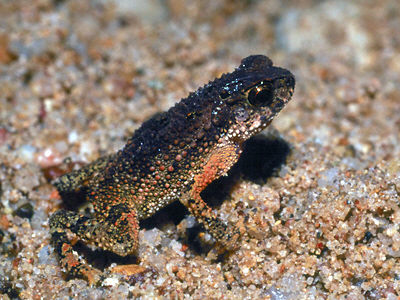
Fig 4
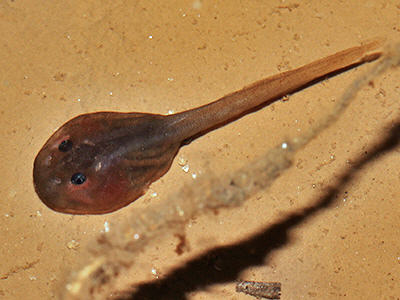 |
Family : BUFONIDAE
Species : Ingerophrynus parvus
Size (snout to vent) : females & males to 52 mm
(Manthey & Grossmann, 1997)
Play call
►
(Selangor, Peninsular Malaysia)
Ingerophrynus parvus
(Lesser Toad, Malayan Dwarf Toad) was first described by George Albert
Boulenger, a Belgian-British zoologist, in 1887 from a specimen taken near
the coastal town of Malacca, Peninsular Malaysia (as Bufo parvus).
This small toad inhabits
lowland tropical forests, and can be found near clear, sandy streams and
amongst leaf litter. It
can jump well, and can climb vegetation.
The dorsal surface is mottled dark
brown to orange-brown, and the skin surface is peppered with tiny warts. The body shape is flat and rectangular, and the forelimbs
are slender.
The pair of cranial ridges, or 'cranial crests' (i.e. the narrow, raised
bony ridges on top of the skull), are brown (compared with
the bright orange cranial ridges of Ingerophrynus chrysolophus in
Thailand). The call is a monotonous rasping sound.
As a consequence of the splitting of Ingerophrynus chrysolophus from the I.
parvus species complex, the range of Ingerophrynus parvus sensu stricto
is now restricted to extreme southern Thailand (Yala province), Peninsular Malaysia,
Sumatra and West Java (Arkhipov et al, 2025).
Northwest of the 'Kangar-Pattani line' (i.e. the boundary which separates
the moist equatorial forests of Peninsular Malaysia from the seasonally
drier forests of Thailand) is the domain of Ingerophrynus chrysolophus;
in the field the latter can be identified by its bright orange cranial
ridges (Arkhipov et al, 2025).
Fig 1 : Example from Kledang Saiong, Perak, Peninsular Malaysia. It was
disturbed from amongst rocky rubble along a forest trail, next to a wet
rock face.
Figs 2 and 3: Examples from a temporary roadside stream in Selangor, Peninsular
Malaysia, at an elevation of 350 metres.
Fig 4 : Adult on a sandbank next to a clear, forest stream in Johor, Peninsular
Malaysia.
Fig 5 : Tadpole from Tioman Island, Pahang, Peninsular Malaysia.
Photo thanks to Law Ing Sind.
References :
Arkhipov, D. V., Pawangkhanant, P., Sarker, G., Gorin, V. A., Bragin, A.
M., Van Nguyen, T., ... & Poyarkov, N. A. (2025). A taxonomic
revision of the Ingerophrynus parvus species complex (Amphibia,
Anura, Bufonidae) with the description of a new species from Thailand.
Herpetozoa, 38, 271-297.
Manthey U., Grossmann W., 1997. Amphibien und Reptilien Sudostasiens.
Natur und Tier - Verlag.
|