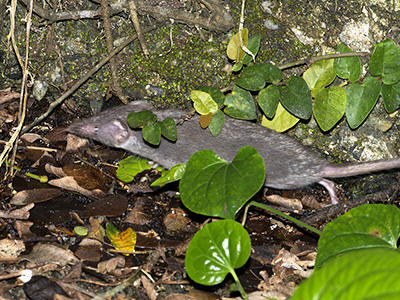
Fig 1
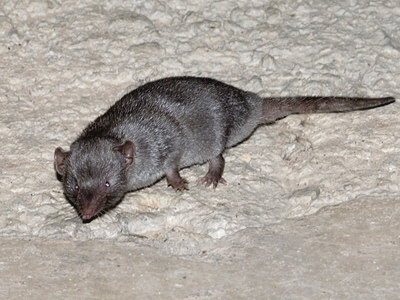
Fig 2
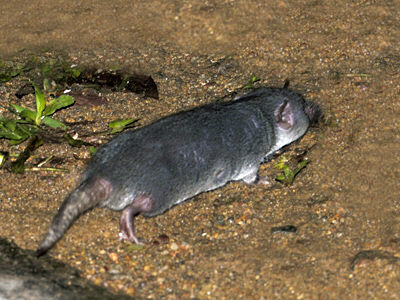
Fig 3
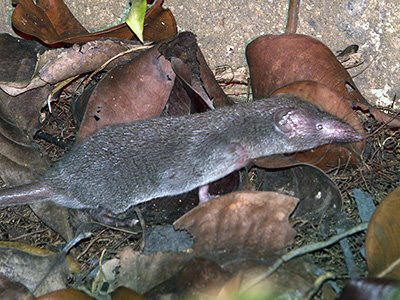
Fig 4
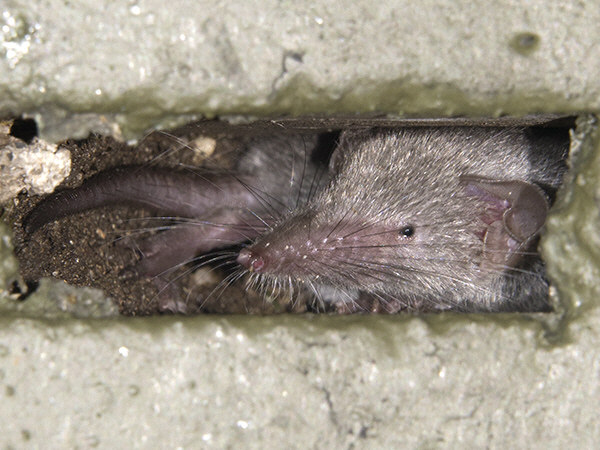
Fig 5
|
Order : EULIPOTYPHLA
Family : Soricidae
Species : Suncus murinus
Head-Body Length :
Up to 15 cm
Tail Length : Up to 8 cm
Weight : Up to 60 grams
The
Brown Musk Shrew, more commonly called the House Shrew, has become adapted
to a quiet, nocturnal existence among agricultural areas, villages, towns
and cities. Unbeknownst to millions of Asia's urban dwellers, this quiet,
unassuming insectivore helps in reducing the population of insects which we
consider pests.
It is possible that the species became introduced to Southeast
Asia many centuries ago by human activities, because 'wild' populations in
natural habitats in this region are largely unheard of.
The species is easily
identified by its pointed snout and short, thick tail : the latter is almost
hairless apart for a few long, sparse hairs. The ears are rounded and
forward facing, and the eyes small. Fur colour varies from grey to brownish
to reddish-grey. On each side of the body is a musk gland which exudes a
strong odour during the mating season.
Two litters of up to 5 young (though usually 3) may be born throughout the
year. The young are known to travel in a convoy train with the mother, each
clamping its jaws tightly to the rear or base of the tail of the preceding shrew. It is reckoned
that the mother can be picked up with all the young hanging from her rump
like a string of pearls.
The House Shrew ranges from Northern Africa, through the Middle East and the
Indian Subcontinent to most of Southeast Asia and the Far East.
Fig 1 : Example from a leafy, suburban neighbourhood in Singapore.
Figs 2 and 3 : Example from a high-density urban housing area. The musk gland can clearly be seen along
the flank (Fig. 3.) as a raised area with a small hairless
centre.
Fig 4 : Example from coastal forest on the island of Sentosa, Singapore.
Fig 5: Taking shelter in a narrow drainage channel at the edge of a golf
course.
References:
Lekagul, B., McNeely, J., 1977. Mammals of Thailand. Association for the
Conservation of Wildlife, Thailand. 758 pp.
Payne, J., Francis, C.M., 1998. A Field Guide to the Mammals of
Borneo. The Sabah Society.
|