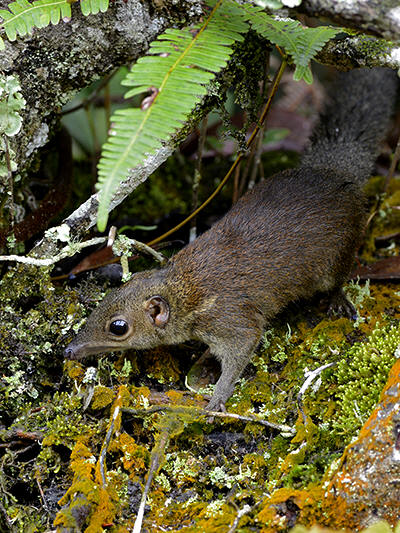
Fig 1
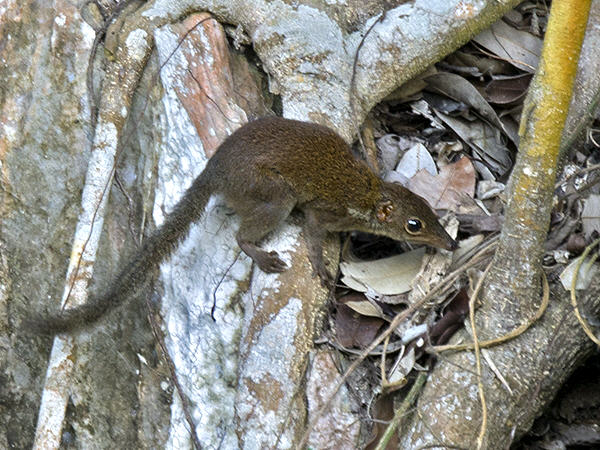
Fig 2
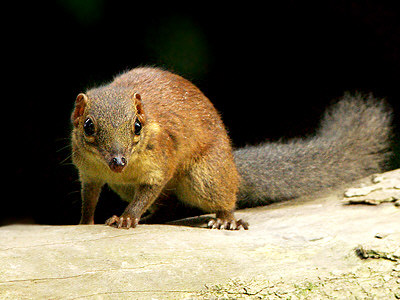
Fig 3
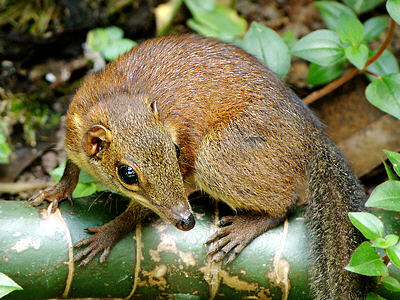
Fig 4
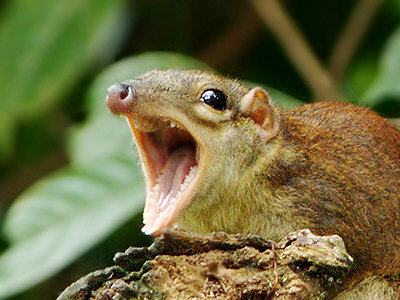
Fig 5
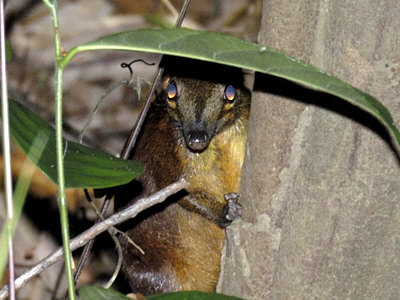
Fig 6
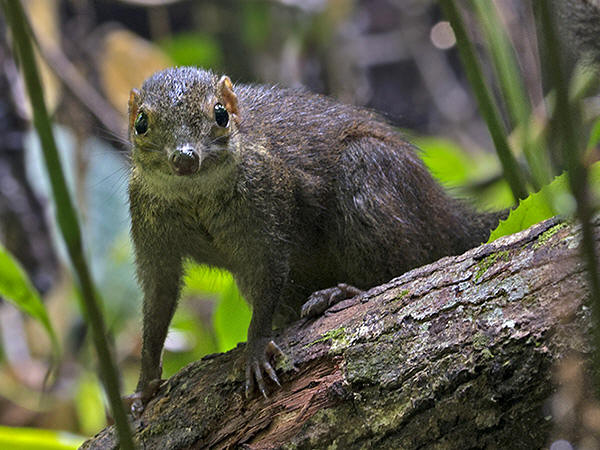
Fig 7
|
Order : SCANDENTIA
Family : Tupaiidae
Species : Tupaia glis
Head-Body Length : 14-20 cm
Tail Length : 12-19 cm
Play vocalisation
►
The Common
Treeshrew Tupaia glis occurs in southern Thailand and Peninsular
Malaysia, including the larger islands of both countries, Singapore, and the
islands of Bintan and Batam the Riau Archipelago of Indonesia.
To the north of its range it is replaced by the
Northern Treeshrew Tupaia belangeri.
It inhabits primary forest and various grades of secondary forest, and
locally can adapt to parklands. It is active by day, either on the forest floor or amongst
low vegetation and fallen branches, where it feeds on insects and fallen fruit.
Its fur colour is variable; specimens from lower montane habitat at Fraser's
Hill, Peninsular Malaysia are brown (Fig. 1), in Singapore it is brown to
reddish-brown, with sub-adults of orange-brown (Fig. 3), and on Bintan
Island is reddish-brown (Fig. 4). There is a narrow, pale stripe on each
shoulder.
Fig 1 : Typical dark brown example from lower montane forest (elevation =
1000 metres) at Fraser's Hill, Peninsular Malaysia.
Fig 2 : Example from Gunung Matsurat, Ipoh, Perak, Peninsular Malaysia.
Figs 3 to 5 : Three images of a sub-adult with
orange-brown fur, from secondary scrub forest in
Singapore. A huge yawn illustrates the size of the Common Treeshrew's gape
in Fig 5.
Fig 6 : Specimen from Bintan Island, Riau Archipelago, Indonesia with reddish
brown dorsal fur, and orange-yellow belly.
Fig 7 : Common Treeshrew in lowland primary forest on the island of Penang,
Peninsular Malaysia.
References :
Francis, C.M., 2001. Mammals of South-east Asia. New Holland.
Payne, J., Francis, C.M., 1998. A Field Guide to the Mammals of
Borneo. The Sabah Society.
|