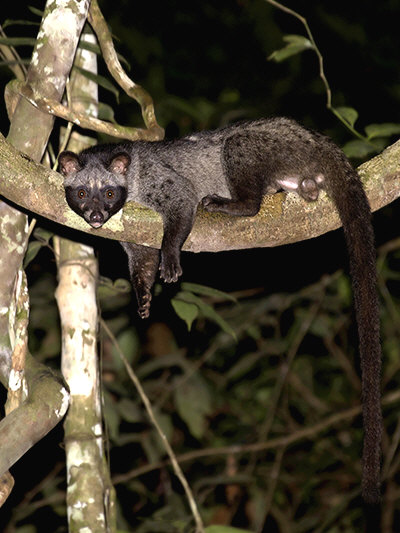
Fig 1
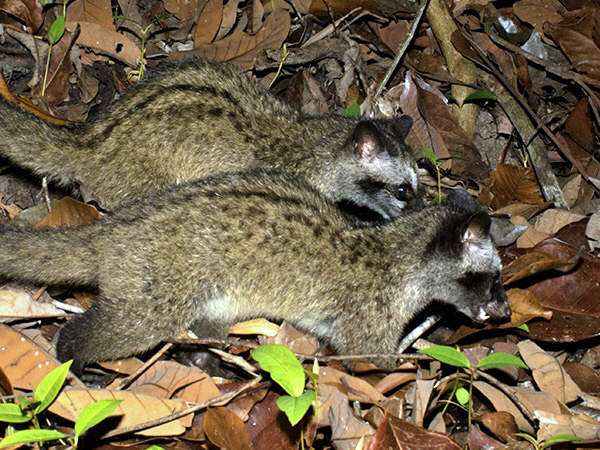
Fig 2
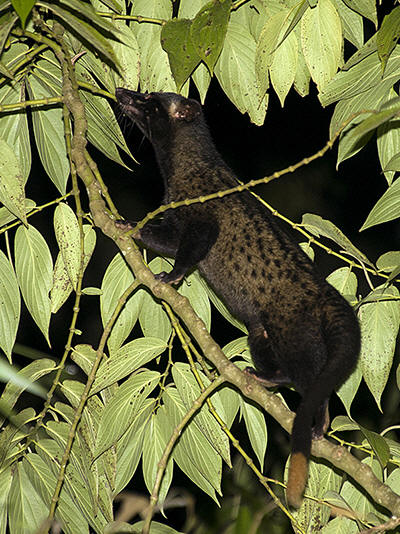
Fig 3
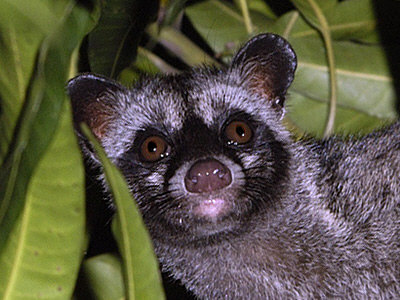
Fig 4
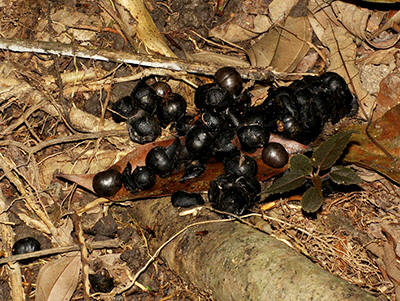
Fig 5

Fig 6
|
Order : CARNIVORA
Family : Viverridae
Species : Paradoxurus musangus
Head-body length : 42-50 cm
Tail length : 33-42cm
Play
call ►
Known to millions of rural
Malays as 'Musang', the Common (or Sumatran) Palm Civet occurs in secondary forests, fruit
orchards, near village houses or in the tops of trees close to human
habitation, indeed it sometimes inhabits the roof spaces of rural
properties. They usually nest, however, in hollow trees where they raise two
or three young. The species is fully nocturnal.
They are identified by the
three dark stripes along the back, on a creamy or grey background, and by
the dark mask across the eyes and nose. They feed mainly on fruits - being
particularly attracted to mangoes, but will also eat worms and insects. In
Singapore they frequently eat the fruits of the Fishtail Palm Caryota
mitis.
The species occurs in Peninsular Malaysia, Singapore, Sumatra and Java.
Closely related species occur in India, southern China and Indochina (Paradoxurus
hermaphroditus) and in Borneo and the Philippines (Paradoxurus
philippinensis) (Veron et al, 2014).
Fig 1 : Male relaxing on a thick liana in lowland forest.
Fig 2 : Juvenile pair in secondary coastal forest.
Fig 3 : Dark adult with orange-tipped tail, an uncommon feature, feeding on the flowers of Piper aduncum,
a non-native invasive species of shrub.
Fig 4 :
Young male, in a mango tree in the Portsdown
area of Singapore.
Fig 5 : Typical droppings of the Common (Sumatran) Palm Civet, comprising seed husks
of Fishtail Palm Caryota mitis.
Fig 6 : Pale specimen from an oil palm plantation.
References :
Francis, C.M., 2001. Mammals of South-east Asia. New Holland.
Payne, J., Francis, C.M., 1998. A Field Guide to the Mammals of
Borneo. The Sabah Society.
Veron, G., M.-L. Patou, M. Tóth, M. Goonatilake & A. P. Jennings, 2014. How
many species of Paradoxurus civets are there? New insights from India and
Sri Lanka. Journal of Zoological Systematics and Evolutionary Research.
p. 1-14. doi: 10.1111/jzs.12085.
Acknowledgments : Audio file courtesy Yong Ding Li.
|