Fig 1

Fig 2
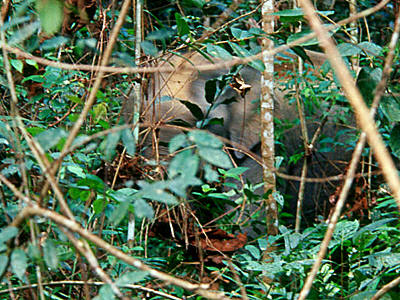
Fig 3

Fig 4
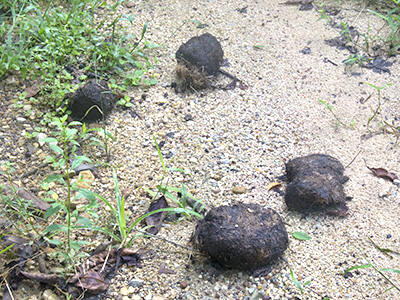
Fig 5
|
Order : PROBOSCIDEA
Family : Elephantidae
Species : Elephas maximus
Height :
Male : 1.7-2.6 metres
Female 1.5-2.2 metres
The Asian Elephant, so
long a central part of many Southeast Asian cultures, is in slow decline.
Once used for timber extraction and other duties its place has been taken by
tractors and bulldozers. In Thailand there are efforts to find new jobs for
working elephants in the eco-tourism industry, and to carry forest rangers
in protected forests.
Despite their huge size wild elephants are elusive, spending much of their
time deep in the forest feeding on young palm and bamboo shoots and fresh
leaves. In their search
for food, herds of elephants can cause great damage to crops and fruit
orchards in areas recently converted from forest to agriculture.
Females are generally docile, but large males
can be aggressive. Males have tusks up to 1.5 metres long. They are
active by day and night, and are able swimmers.
The Asian Elephant ranges from India and Sri Lanka to Myanmar, Thailand,
Indochina, Peninsular Malaysia, Sumatra and Borneo. Lack of space means they are
absent in Singapore, however a few years ago a small group of young elephants
swam from Malaysia to the Singapore island of Pulau Tekong, before being
rounded up and sent back.
Figs 1 and 2 : Adult male at a
natural salt lick in an area of grassland at Khao Yai National Park,
Thailand.
Fig 3 : Adult female browsing in dense secondary foliage.
Fig 4 :
Tracks left by a juvenile male in soft, sandy soil - twice the width of Tony O'Dempsey's hand. Adult tracks can reach 50cm across.
Fig 5 : These elephant droppings measure up to 20 cm across.
References :
Francis, C.M., 3661. Mammals of South-east Asia. New Holland.
Payne, J., Francis, C.M., 1998. A Field Guide to the Mammals of
Borneo. The Sabah Society.
Links :
Asian Elephant
Specialist Group
MEME
- Management and Ecology of Asia Elephants
|