Fig 1
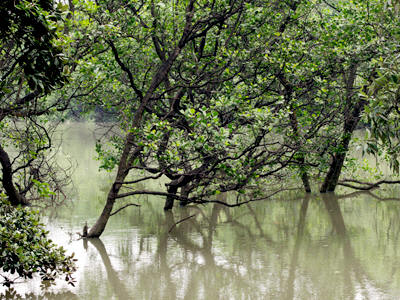
Fig 2
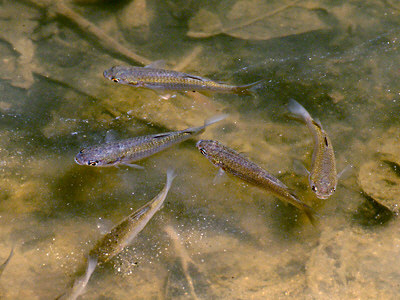
Fig 3
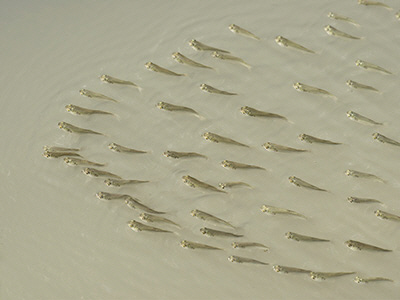
Fig 4
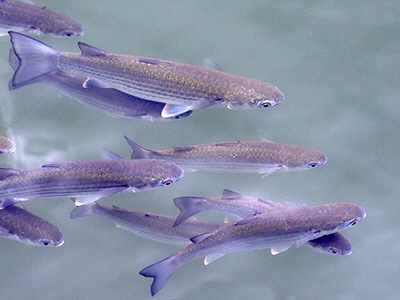
Fig 5
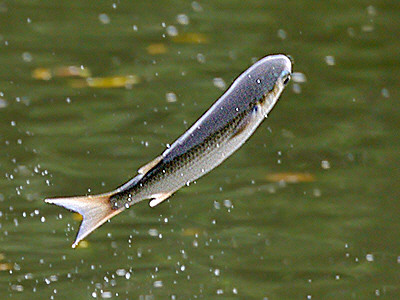
Fig 6
|
Order : Mugiliformes
Family
: MUGILIDAE
Species : Globally more than 70 species in 17 genera.
Maximum Length : different species range in length from 6 cm to over
80 cm.
Mullets (or 'grey
mullets') are surface
dwelling fish, occurring predominantly in shallow coastal habitats, such as
reefs, estuaries and mangrove. Some species are attracted to man-made
structures such as boat jetties and marinas.
Globally more than 70 species are recognised from 17 genera, although most
are from just two genera - Liza and Mugil. Large
species of mullet can grow to over 80 cm long, but most are smaller
reaching 10 to 30 cm in size. Typically they occur in large shoals when
young, but larger specimens become more solitary.
Mullets are plain-coloured, typically with silvery flanks and dark grey to
greenish dorsums. Faint lateral stripes may sometimes be present. They are
strong swimmers: their bodies are elongate and torpedo-shaped. Their tail
fins are squarish to moderately forked, and there are always two separate
dorsal fins.
Their mouths are small, and they feed on organic or algal detritus which is
either taken from the surface, or is sifted from sandy or muddy substrates.
They tend to advance into shallow waters with the rising tide, sometimes
congregating at the mouths of small freshwater streams which discharge into
mangrove areas.
Mullets occur worldwide, in both tropical and temperate seas. At least 20
species are likely to occur in Southeast Asia including the
Squaretail Mullet Ellochelon
vaigiensis.
Fig 1 : A trio of mullets (possibly the Greenback Mullet Liza
subviridis), measuring around 15 cm, photographed at high
tide in a shallow mangrove inlet at Sungei Pandan, Singapore.
Fig 2 : Flooded mangrove forest at high tide, at Sungei Pandan,
Singapore : mullets will follow the rising tide into shallow waters to
feed.
Fig 3 : A group of mullet, measuring around 8 cm, stranded in a back-mangrove pool during low tide
at Bako National Park, Sarawak, Borneo. The fish at bottom left is
sifting detritus from the substrate.
Fig 4 : A shoal group of mullet fry, in a mangrove inlet at Langkawi,
Peninsular Malaysia
Fig 5 : A group of mullet at Sungei Buloh, Singapore.
Fig 6 : A mullet leaps from the water at Sungei Buloh, Singapore: this
is tentatively a Flathead Grey Mullet Mugil cephalus, a species
which is locally reared in floating fish farms and has established a
feral population in the area.
References :
Allen, G. 1988. Marine Fishes of Southeast Asia. Western Australian
Museum.
Lim, K.P. and Low, K.Y. 1998. A Guide to Common Marine Fishes of
Singapore. Singapore Science Centre.
|