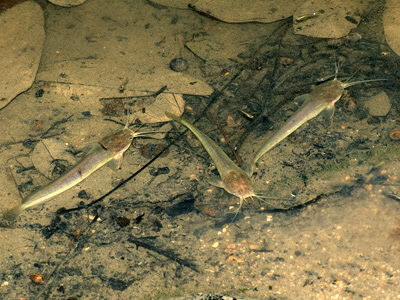
Fig 1
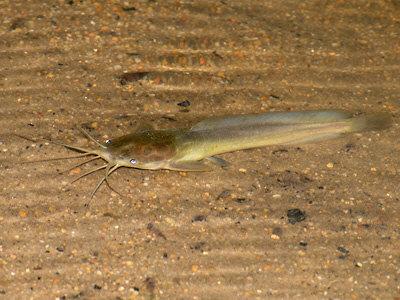
Fig 2

Fig 3
|
Order : Siluriformes
Family : CLARIIDAE
Species : Clarias batrachus
Maximum Length : 47 cm
The Common Walking Catfish
is an adaptable species able to survive in disturbed, stagnant or somewhat
polluted waterbodies such as rural streams, rice paddies, concrete drainage
channels or man-made ponds, lakes and swamps. During flooded or rainy
conditions this species can move from one water body to another overland.
Adults can reach up to 47 cm in length, though most fully grown specimens
are around 30 cm or so. Its body colour is greyish or pale brown, and its
head is reddish brown. There are narrow bands of pale spots on the flanks,
though these are often faint.
It possesses four pairs of long barbels, which are sensory devices used to
locate food prey, which comprises other fish, aquatic invertebrates such as
shrimps or insect larvae, and aquatic plants. The barbels also allow this
nocturnal species to navigate amongst sunken debris at night. By day it lies
concealed in muddy substrate or beneath fallen leaves, logs or other debris.
It can be distinguished from the similar
Forest Walking Catfish Clarius
leiacanthus by only having a narrow gap between the leading edge of the
long dorsal fin and the trailing edge of the bony plates on top of the head.
In addition, the head is more oval and rounded than that of the Forest
Walking Catfish, which is more squarish in outline.
Clarias batrachus occurs in many parts
of Southeast Asia, and has been introduced outside its native range. In
Singapore, this native species has been displaced in many waterways by
Clarias gariepinus, an introduced catfish originally from Africa (Tan et
al, 2020).
Figs 1 to 3 : Common Walking Catfish from
shallow, rural stream with sandy substrate and accumulations of
rotting leaf litter.
All photos taken in Singapore.
References :
Baker, N. & K. Lim, (Vertebrate Study Group, Nature Society Singapore),
2008. Wild Animals Of Singapore. Draco Publishing and Distribution Pte. Ltd.
Tan Heok Hui, Kelvin Lim Kok Peng, Liew Jia Huan, Low Bi Wei, Rayson Lim
Bock Hing, Jeffrey Kwik Teik Beng & Darren C. J. Yeo (2020). The non-native
freshwater fishes of Singapore: an annotated compilation. Raffles Bulletin
of Zoology, 68: 150-195.
|