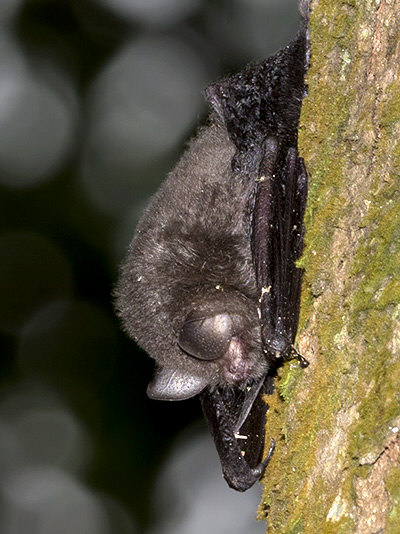
Fig 1
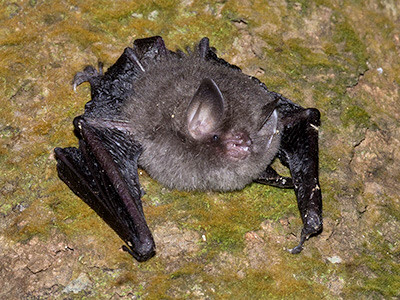
Fig 2
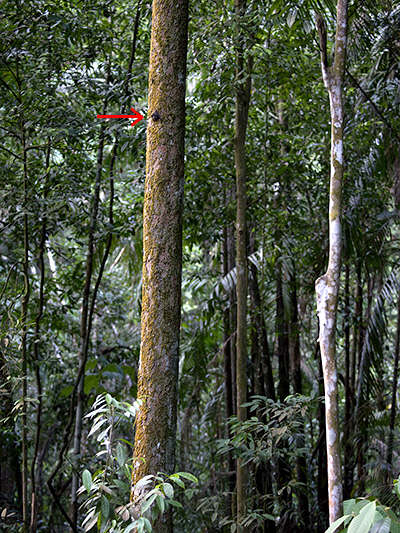
Fig 3
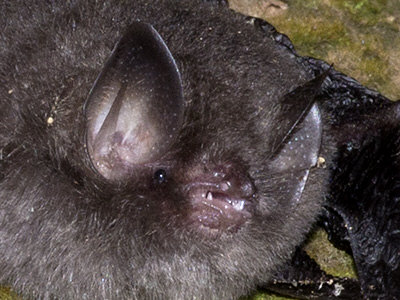
Fig 4
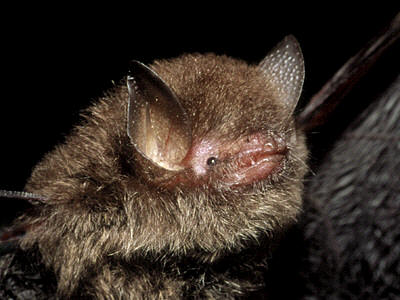
Fig 5
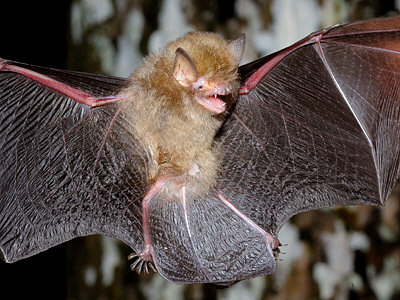
Fig 6

Fig 7
|
Order : CHIROPTERA
Family : Vespertilionidae
Species : Kerivoula spp.
Forearm Length : up to
4.9 cm
Weight : up to 13 grams
Woolly Bats (Kerivoula
spp.) are mainly small
insectivorous bats which, in Southeast Asia, inhabit primary and secondary forest.
Globally there are more than 20 species of Kerivoula. Shepherd (2012)
lists 12 species as occurring in Southeast Asia. Another 3
species occur in New Guinea, and 7 more in Africa.
Woolly Bats are characterised by long, thick, fluffy fur which covers much of the face.
Fur colour is variable both between species and within species, but is
typically orange-brown.
The ears are somewhat rounded, funnel-like and barely extend above the fur on
top of the domed skull. The distinctive tragus (a bony projection inside the
ear) is narrow, pointed and
projects upwards (see Figure 4).
The eyes are tiny and the mouth is small. The tail is fully enclosed in the
flight membrane.
In Southeast Asia's forests, these bats typically roost in small tree holes,
or in clumps of hanging vegetation such as dead leaves. Figures 1 to 4 are
of a woolly bat found, rather unusually, roosting on a tree trunk, 4 metres
from the ground - perhaps its regular roost had been disturbed in some way
earlier in the day.
Hardwicke's Woolly Bat K. hardwickii (see Figure 6) is the most
widespread species in the region occurring in India, Sri Lanka, Myanmar, southern China, Thailand, Laos,
Vietnam (and probably Cambodia), Peninsular Malaysia, Singapore and parts of
Indonesia. Francis (2008) indicates that K. hardwickii is probably a
species complex: further work will likely reveal hidden, undescribed
species.
Figs 1 and 2 : Kerivoula sp. from lowland secondary forest in
Singapore. The pelage (fur) of this bat appears more grey than is typically
reported. Note the pointed tragus inside the ear, which confirms this
bat as a Kerivoula sp.
Fig 3 : Habitat in typical lowland secondary forest, in Singapore's central
forests. The red arrow indicates the location of the bat shown in Figures 1 and 2.
Daytime roosting on tree trunks is not considered typical behaviour for
woolly bats.
Fig 4 : Close-up of the same specimen, showing the pointed tragus inside the
ear.
Fig 5 : Kerivoula sp. - either the
Small Woolly Bat
K. intermedia or Least Woolly Bat K. minuta. (These two species
occur in Peninsular Malaysia and Borneo. K. minuta also extends to southern
Thailand.)
Fig 6 : Hardwicke's Woolly Bat
K. hardwickii, from lowland secondary forest, Singapore.
Fig 7 : Frequency modulated (FM) call with a start frequency of 245 kHz
and an end frequency of 70 kHz, recorded in secondary forest, Singapore. (The frequency scale, on the left side, is from
0 to 250 kHz, and the time scale at bottom is 0-42 milliseconds). This call is identified as
Kerivoula hardwickii with reference to Table 11 in Douangboubpha et al
(2016).
Thanks to Matt Struebig of the School of Biological & Chemical Sciences,
Queen Mary, University of London for his assistance.
References :
Douangboubpha, B., Bumrungsri, S., Satasook, C., Wanna, W., Soisook, P. &
Bates, P. J. (2016). Morphology, genetics and echolocation calls of the
genus Kerivoula (Chiroptera: Vespertilionidae: Kerivoulinae) in
Thailand. Mammalia, 80(1), 21-47.
Lekagul, B., McNeely, J., 1977. Mammals of Thailand. Association for the
Conservation of Wildlife, Thailand. 758 pp.
Payne, J., Francis, C.M., 1998. A Field Guide to the Mammals of
Borneo. The Sabah Society.
Shepherd, C., Shepherd, L., 2012. A Naturalist's Guide to the Mammals of
Southeast Asia. John Beaufoy Publishing.
|