Fig 1
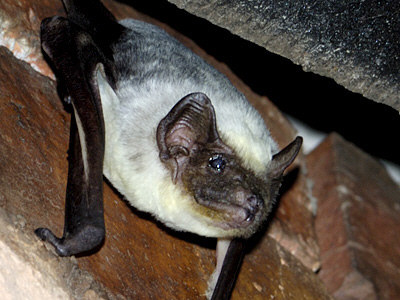
Fig 2
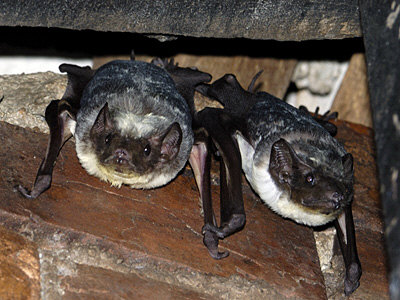
Fig 3
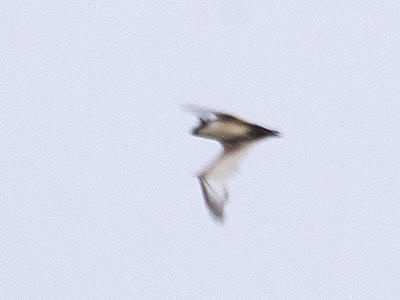
Fig 4
|
Order : CHIROPTERA
Family : Emballonuridae
Species : Saccolaimus saccolaimus
Forearm Length : up to
7.8 cm
Weight : up to 60 grams
Saccolaimus saccolaimus
(Pouched Tomb Bat, Pouch-bearing Bat) is a distinctive species which has adapted well to
habitat disturbance and a semi-urban environment. Roosts have been found in rock
crevices and tree holes, as well as abandoned buildings.
This bat typically has white to grey fur on
the throat, belly and parts of the back, and partly white wings. In some
specimens the grey fur on the dorsum may be dappled with white. In flight
the long, narrow wings may appear translucent.
The 'pouch' in its name refers to a glandular pocket located under its chin
(the gular pouch), which can emit a strong odour. Closely related species
may have a small pocket located at the wrist (the radio-metacarpal pouch),
which the Pouched Tomb Bat lacks.
In flight the echolocation call of this species, which comprises a constant
frequency (CF) pulse of around 20-25 kHz, can sometimes be detected by the
human ear.
The Pouched Tomb Bat is widespread and ranges from India and Sri Lanka
through Myanmar, Thailand, Peninsular Malaysia and Singapore to Sumatra, Java,
Borneo and other Indonesian islands. The eastern extent of its range
includes New Guinea and parts of northern Australia.
Fig 1 : Calling loudly whilst emerging from a roost inside a brick chimney.
Fig 2 : This example has extensive white fur not
only on its throat, belly and flanks, but also on
its back.
Fig 3 :
Pair clinging to the brickwork of an abandoned
building, Singapore.
Fig 4 : Flying high in the sky, just before dusk. Note the translucent
wings.
References :
Lekagul, B., McNeely, J., 1977. Mammals of Thailand. Association for the
Conservation of Wildlife, Thailand. 758 pp.
Payne, J., Francis, C.M., 1998. A Field Guide to the Mammals of
Borneo. The Sabah Society.
|