 |
Order : PRIMATES
Family : Hylobatidae
Species : Hylobates moloch
Head-body length : 45-64 cm
Tail length : no tail
Weight : up to 9 kg
Play
call ►
The Javan Gibbon, also
called the Silvery Gibbon or 'Owa Jawa', inhabits tall, primary forest on the island of Java.
As nearly all tall, lowland forest on Java is now gone, this species
survives in fragmented forests on the slopes of mountains and volcanoes,
either active or extinct. This is the only gibbon species living on the
island.
A review of the species status by IUCN (Nijman,2020) concluded the species
should be categorised as Endangered.
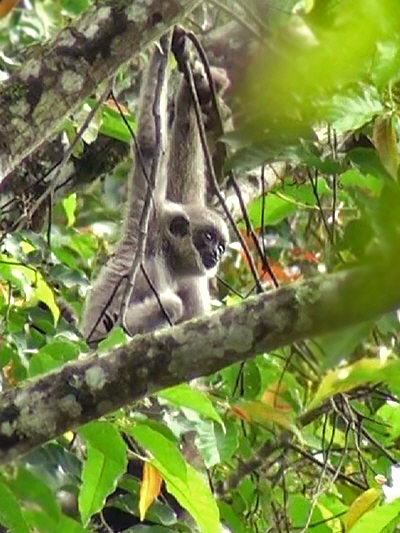
Its fur is typically described as 'silvery-grey' but in many specimens it is
brownish. The facial skin is very dark, and this is framed above and
below by pale fur on the brow and chin. Sometimes the cheeks are pale too,
thus the entire face may be framed with pale fur.
In
some specimens the top of the head (the 'cap') is much darker, but in other
specimens this feature is absent.
In the morning the female produces complex, loud, hooting calls
which may carry several kilometres. The males also vocalizes, but his calls
are apparently limited to simple 'hoots'.
As with all gibbons, this species is diurnal and arboreal, rarely coming to
ground. It subsists mainly on forest fruits, as well as young
leaves, flowers and, reportedly, occasional insects.
The species is endemic to Java, occurring only in suitable forest in the provinces of West Java
and Central Java.
Fig 1 : Adult specimen photographed at
Mount Halimun, West Java, Indonesia at around 1000 metres elevation. Photo
thanks to Andie Ang.
References :
Nijman, V. 2020. Hylobates moloch. The IUCN Red List of Threatened
Species 2020: e.T10550A17966495.
Acknowledgments : Audio file courtesy Yong Ding Li.
|