 |
Family : AGAMIDAE
Species : Calotes bachae
Size (snout to vent) : up to 9.7 cm
Size (total length) : up to ~ 25 cm
First
described in 2013 (Hartmann et al, 2013), Calotes bachae (Vietnamese
Blue Crested Lizard) was formerly treated as a variant of Calotes
mystaceus.
This distinctive agamid occurs in southern Vietnam east of the Lower
Mekong river (Dong Nai, Binh Phuoc, Dak Lak, Lam Dong, Ba Ria – Vung Tau,
and Tay Ninh provinces).
It inhabits natural and human-impacted habitats to the west and north of Ho Chi Minh
City, and can be found within some of the city's parks and gardens.
Its range appears
to also extend into parts of neighbouring Cambodia and southern Laos.
(Hartmann et al, 2013).
It is fully diurnal, and mainly arboreal. It feeds on a range of insects, and rests overnight on
the extremities of narrow branches.
Genetic sequencing clearly confirms this agamid as a separate species to Calotes
mystaceus.
Calotes bachae differs most visibly from Calotes
mystaceus by the near absence of dark brown markings on its upper
flanks. Its nuchal (neck) crest and dorsal crests are continuous and of
modest length.
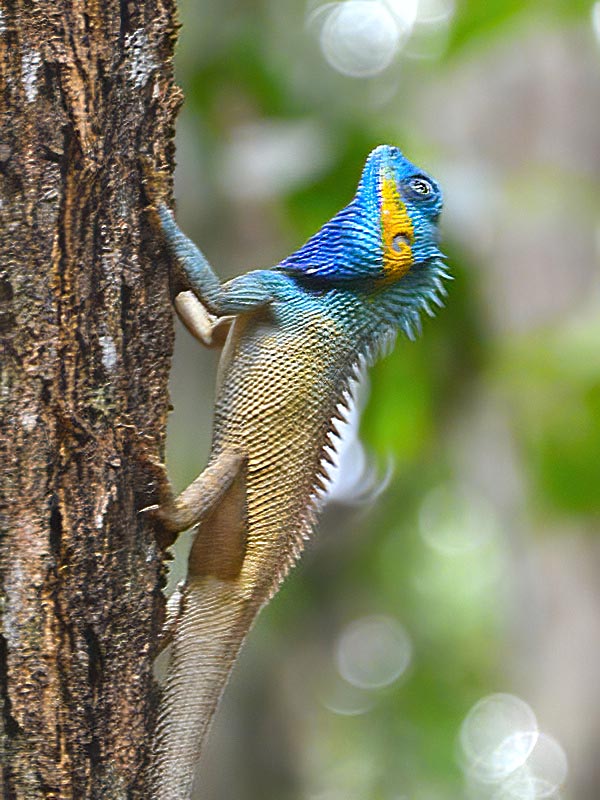
The head is bluish-turquoise; this colour extends only to behind the front
limbs (whereas in Calotes mystaceus much of the body can also be
blue). There is a broad cream to yellow stripe on the head, which extends from
beneath the eye to behind the tympanum (external ear drum).
Males develop stronger colouration during the February-March breeding
season.
Juveniles are mottled brown.
Fig 1 : Male example with bright yellow facial stripe encountered
during the month of February, during the breeding season, in lowland,
secondary forest at Cu Chi, southern Vietnam.
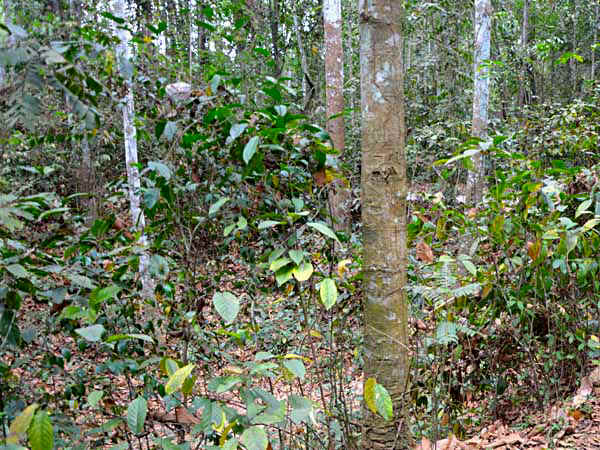
Fig 2 : Lowland, secondary, dry broadleaf forest at Cu Chi, southern
Vietnam.
All photos thanks to Andy McMillan.
References :
Hartmann, T., Geissler, P., Poyarkov Jr, N. A., Ihlow, F., Galoyan, E.
A., Roedder, D., & Boehme, W. (2013). A new species of the genus Calotes
Cuvier, 1817 (Squamata: Agamidae) from southern Vietnam. Zootaxa,
3599(3), 246-260.
|