 |
Order : RODENTIA
Family : Hystricidae
Species : Trichys fasciculata
Head-Body Length : up to 44 cm
Tail Length : up to 24 cm
Weight : up to 2 kg
The Long-tailed Porcupine is the only species in
the genus Trichys. It occurs in a wide range of habitats including
lowland forest of different types (primary, secondary, forest edge) up to 900 metres elevation, and cultivated
areas. It is nocturnal in habits, and sleeps by day in burrows.
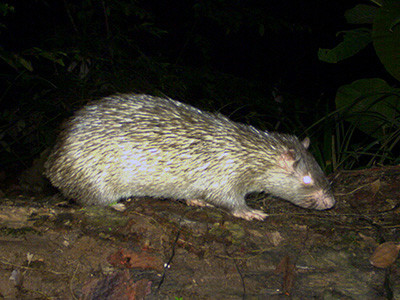
Its spines or quills are pale at the base and brown at the tip. These
generally lie flat on the body, and as a consequence its body shape is rather like a
large rat. Its upperparts are brown and its underside is pale.
This species is considerably smaller than the
widespread Malayan Porcupine
Hystrix brachyura.
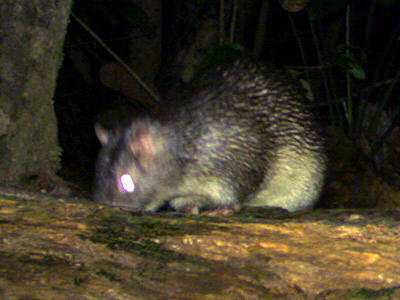
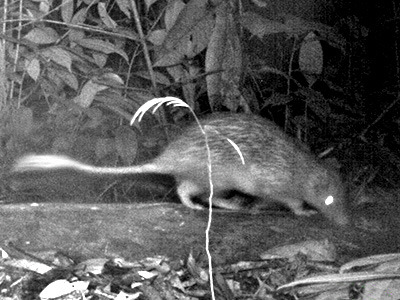
Its long tail, which bears a small brush of bristles at the tip, is often
lost (as in the example in Figure 2) : this can cause some confusion when trying to identify the species
from photographs. Quite why this occurs is unclear, but it may sometimes
be a result of attack by a predator.
It feeds on a variety of vegetable matter including
fallen seeds, shoots and roots. Many species of porcupine are food
hoarders, collecting fallen fruits and seeds and carrying them to favoured
storage areas, and they therefore play a role in seed dispersal.
The Long-tailed Porcupine occurs in Sumatra, some parts of Peninsular Malaysia
(restricted to western areas ?) and
Borneo, where it may be locally common. There are no records from
Singapore.
Fig 1 : Example from Gunung Leuser, Sumatra. Photo thanks to Matthew Luskin.
Figs 2 and 4 : Example from Lambir Hills, Sarawak, Borneo making use of a
fallen tree to traverse an area of soft mud next to a stream. This specimen
has lots its entire tail.
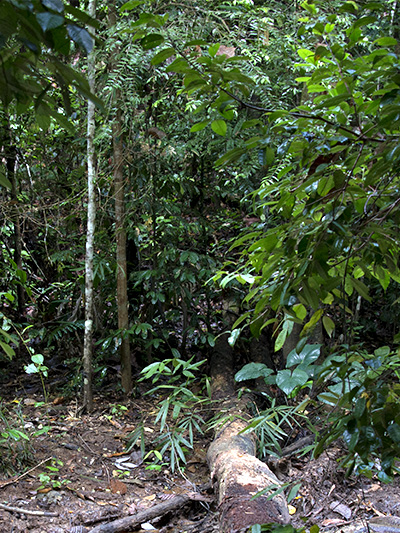
Fig 3 : Boggy, forest edge habitat at Lambir Hills.
References :
Francis, C.M. 2019. A Field Guide to the Mammals of South-east Asia. Second
Edition. Bloomsbury Publishing. 416 pp.
Payne, J., Francis, C.M., 1998. A Field Guide to the Mammals of
Borneo. The Sabah Society
|