Fig 1
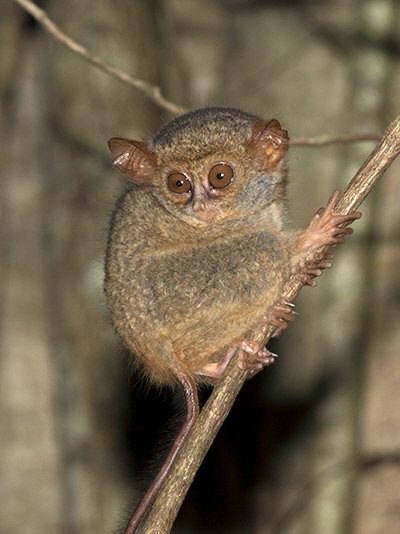
Fig 2
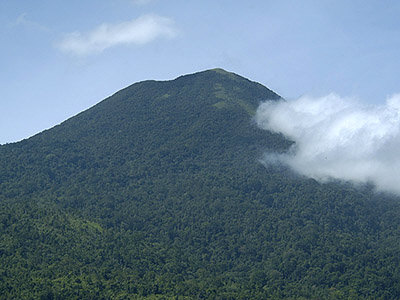
Fig 3
|
Order : PRIMATES
Family : Tarsiidae
Species : Tarsius spectrumgurskyae
Head-body length : 14 cm
Tail length : 24 cm
Weight : 130 grams
Play
call ►
Gursky's Spectral Tarsier is amongst the smallest of
all primates. Tarsiers are nocturnal, forest specialists. By day they roost in small social groups in tree holes or crevices,
particularly amongst the complex trunks and vertical root structures of
figs. At dusk they emerge from their hiding place and will spend an hour or
so resting prior to exploring the surrounding forest for their food prey -
mainly insects, such as beetles and grasshoppers, or perhaps small
vertebrates such as lizards. The young will be left near the roosting site
while the adults search for food.
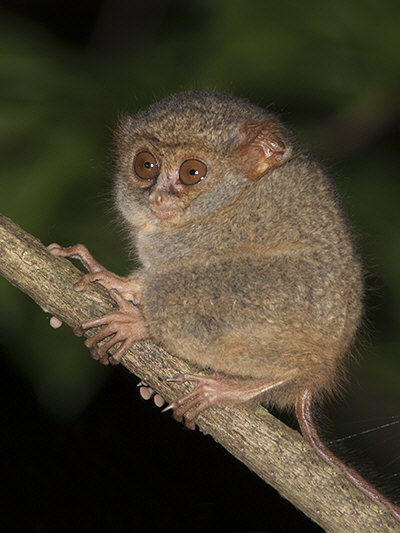
They are supremely adapted for night-time hunting, with large ears for
detecting the movement of insects, and large eyes for nocturnal vision. The
forward-facing eyes have limited movement in their sockets, but the neck can
rotate 180 degrees in each direction to allow all-around vision.
They have long legs for leaping up to 6 metres from
tree to tree with remarkable agility, and come to ground if prey has been
sighted or if in need of water. The long, bony, fingers and toes have
rounded pads, and the second and third toes also have pointed claws which
are used for grooming. The tail is long, with thin hair at the distal end.
Gursky's Spectral Tarsier only occurs on the central Indonesian island of
Sulawesi.
Figs 1 and 2 : Two adult specimens of
Gursky's Spectral Tarsier from Tangkoko
National Park, North Sulawesi, Indonesia.
Fig 3 : The slopes of Mount Tangkoko - stronghold of Gursky's Spectral Tarsier.
References :
Shekelle, M., Groves, C. P., Maryanto, I. & Mittermeier, R. A. (2017). Two
new tarsier species (Tarsiidae, Primates) and the biogeography of Sulawesi,
Indonesia. Primate Conservation, 31, 61-69.
Acknowledgments : Audio file courtesy Yong Ding Li. |