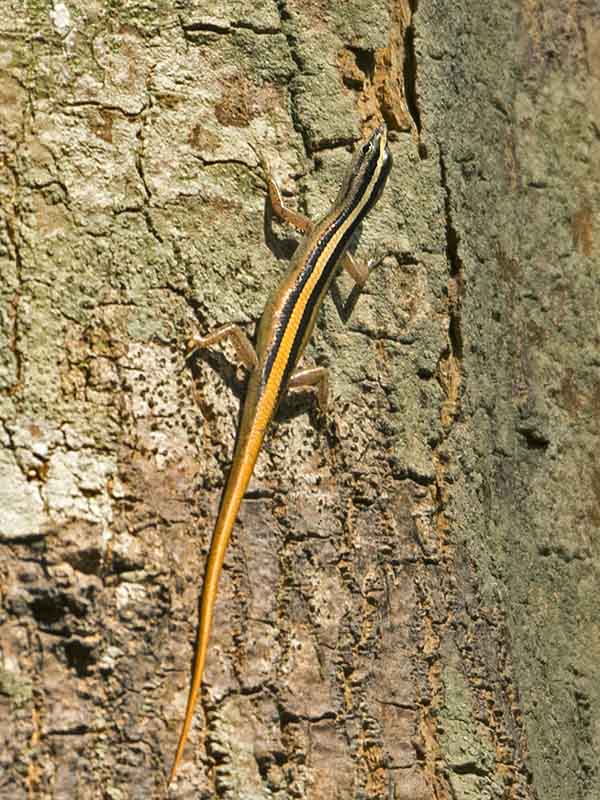
Fig 1
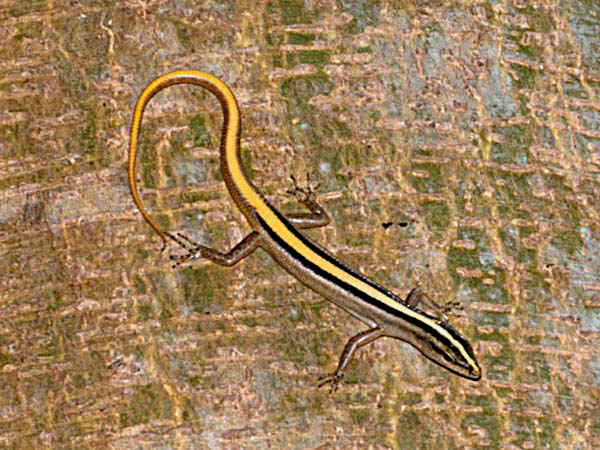
Fig 2
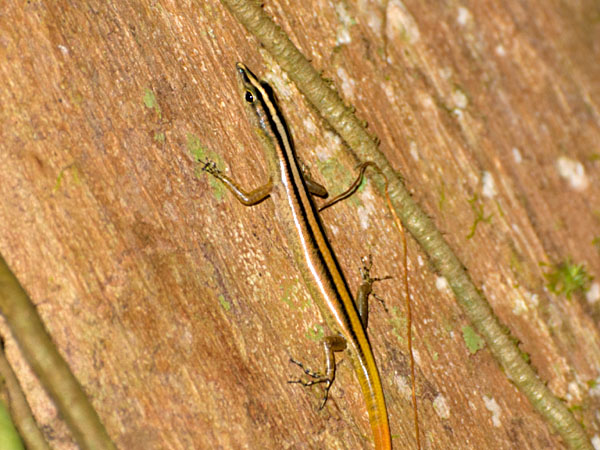
Fig 3
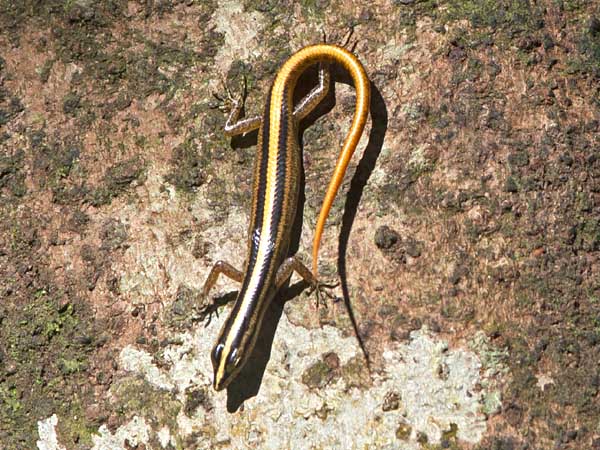
Fig 4
|
Family : SCINCIDAE
Species : Lipinia vittigera
Size (snout to vent) : to ~ 4 cm
Size (total length) : to ~ 10 cm
Lipinia vittigera
is an easily overlooked, slender-bodied skink which occurs in Singapore, Peninsular Malaysia (including the islands of Penang
and Tioman), southernmost Thailand, the Mentawai islands off the west coast
of Sumatra, and (parts of) Borneo; the northern limit of the species is
uncertain (Nikolay et al, 2019).
Specimens from Tioman, off the east coast of Peninsular Malaysia, have a
much narrower yellow vertebral stripe than examples from the mainland
(Grismer, 2011).
The English name 'Yellow Striped Tree Skink', as used in Singapore, is the preferred name, being both descriptive and ecologically
accurate. The
species was first described from Sipora Island, part of the Mentawai Islands
group in Indonesia, and is thus also referred to as 'Sipora Striped Skink'.
Lipinia vittigera mainly occurs on tree trunks and
branches, particularly where bark crevices allow an easy grasp; individuals
can quickly retreat into such crevices when threatened.
It occurs in primary and tall secondary forest in lowlands and
hills to around 600 metres elevation (Grismer, 2011). It is strictly
diurnal, and can be observed foraging for small insect prey, sometimes in direct
sunlight.
It is easily identified by its yellow vertebral stripe, bounded on each side
by a black stripe. The upper surface of the tail is also yellow
(yellowish-orange in smaller, juvenile specimens).
The tail is highly flexible; the posterior part of the tail can be curled
back 180 degrees to lie parallel with the anterior part. Sometimes the tail
is moved in a flexing, sinuous motion.
In Indochina, related species of the Lipinia vittigera complex are
now recognised as distinct species (Nikolay et al, 2019). For example, Lipinia
microcerca (Banded Lipinia).
Fig 1 : Example from primary, lowland forest at the base of Penang Hill, Pulau
Pinang, Peninsular Malaysia
Fig 2 : Example from primary, lowland forest at Bukit Timah,
Singapore.
Fig 3 : This skink was encountered in tall, secondary forest at Gunung Pulai, Johor,
Peninsular Malaysia.
Fig 4 : Example from tall, secondary forest at Taiping, Perak, Peninsular
Malaysia. Note the extremely flexible tail.
References :
Grismer, L.L., 2011. Lizards of Peninsular Malaysia, Singapore and their
Adjacent Archipelagos. Edition Chimaira.
Nikolay A. Poyarkov Jr., Peter Geissler, Vladislav A. Gorin, Evgeniy A.
Dunayev, Timo Hartmann, Chatmongkon Suwannapoom (2019). Counting
stripes: revision of the Lipinia vittigera complex (Reptilia, Squamata,
Scincidae) with description of two new species from Indochina.
Zoological Research, 2019, 40(5): 358-393.
|