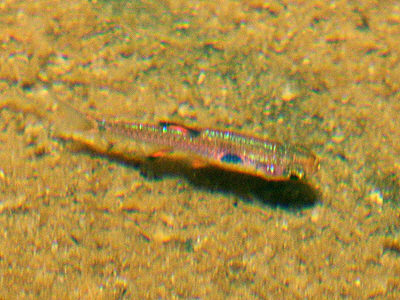
Fig 1
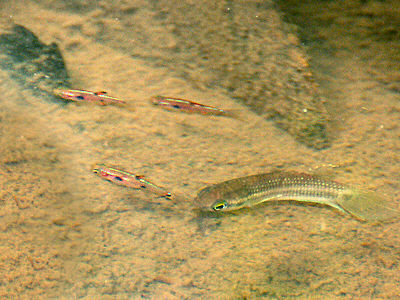
Fig 2
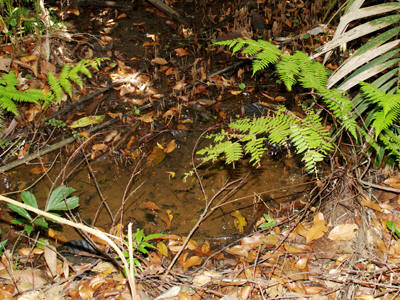
Fig 3
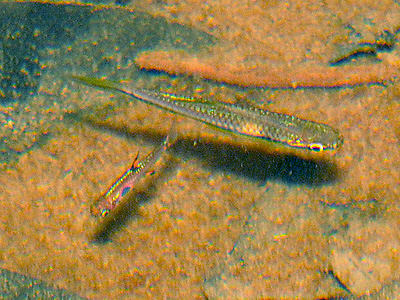
Fig 4
|
Order : Cypriniformes
Family : DANIONIDAE
Species : Boraras maculatus
Standard Length (excludes tail) : 2.5 cm
(Fishbase 2026)
The genus Boraras
contains, as of 2026, just 6 valid species, all of which occur in Southeast
Asia (Fishbase, 2026).
Boraras maculatus (Pygmy
Rasbora, Dwarf Rasbora, Spotted Rasbora) inhabits slow-moving, shallow, acidic forest streams
in
freshwater swamp forest and peat swamp habitats in Peninsular Malaysia,
Singapore, Sumatra and the Riau Islands (with unconfirmed records from Surat
Thani [Thailand] and Kalimantan [Borneo]). (IUCN - Ahmad, 2019).
In the
field it is easily overlooked due to its small size, but once located its
identity is easily confirmed by its pinkish-orange colour and by the presence of a prominent, circular
dark spot on each flank (this feature can help distinguish it
from the larger Harlequin Rasbora). Its
dorsal and anal fins are red with black margins, and there is a small
dark spot at the base of the anal fin and tail fin.
This tiny species, of less than 3 cm length, often occurs in mixed shoals with other, larger species of
rasbora.
A study of disconnected/isolated acidic water habitats in Peninsular Malaysia concluded
that despite there being significant genetic divergence between different
populations of
Boraras maculatus, as a result of millions of years of isolation,
there was little apparent change in their morphology (i.e. their internal
and external structure, appearance and patterning). The study concluded that this was a case of
'morphological stasis in a stenotopic miniature species' (Fam et al, 2024).
Fig 1 : Pygmy Rasbora in freshwater swamp
forest habitat in Singapore.
Fig 2 : Trio of Pygmy Rasbora next to a
Forest Betta (Betta pugnax) in Singapore.
Fig 3 : Typical habitat of Boraras maculatus - a shallow, silty, acidic stream
with leaf litter detritus in
freshwater swamp forest.
Fig 4 : A lone Pygmy Rasbora with a much larger
Einthoven's Rasbora (Rasbora
einthovenii) in Singapore.
References and links :
Ahmad, A.B. 2019. Boraras maculatus. The IUCN Red List of
Threatened Species 2019: e.T169519A89800398.
Fam, Y. Q., Jamaluddin, J. A. F., Muhammad‐Rasul, A. H., Ilham‐Norhakim,
M. L., Rosely, N. F. N., & Lavoué, S. (2024). Contrasting genetic and
morphological differentiation among geographical lineages of a
stenotopic miniature rasborine, Boraras maculatus, in Peninsular
Malaysia. Journal of Fish Biology, 104(1), 171-183.
Ho Jonathan K. I., Sorain J. Ramchunder, Andrew Memory, Meryl Theng, Li
Tianjiao, Esther Clews, Cai Yixiong, Tan Heok Hui & Darren C. J. Yeo. (2016). A
Guide to the Freshwater Fauna of Nee Soon Swamp
Forest. Singapore: Lee Kong Chian Natural History Museum & Tropical Marine
Science Institute, National University of Singapore. 139 pp.
Fishbase -
Boraras maculatus
|