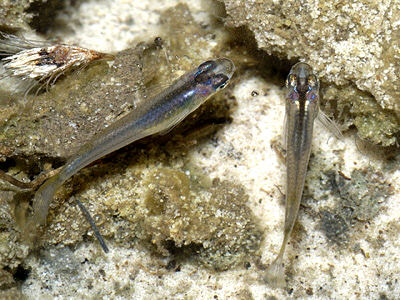
Fig 1
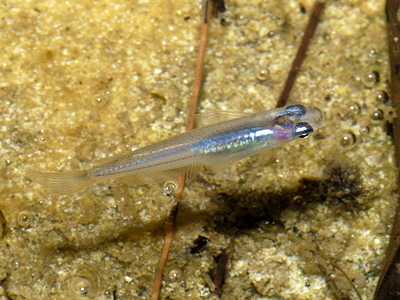
Fig 2
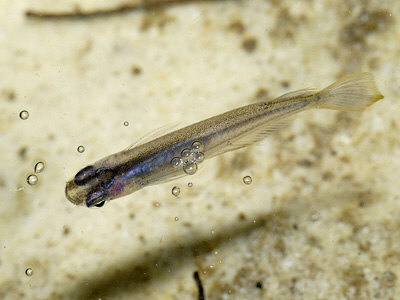
Fig 3
|
Order : Beloniformes
Family : ADRIANICHTHYIDAE
Species : Oryzias javanicus
Maximum Length : 4.5 cm
The Javanese Ricefish
typically inhabits brackish streams and ponds in coastal and mangrove zones,
but is also known to venture upstream into fresh water. It is
surface-dwelling, often forming large shoals.
Reaching just 4.5 cm in length this small, but attractive, species has a
translucent body in which the internal organs are clearly visible. The skin
is virtually colourless, apart from the cheeks which are purplish or pink.
The tail fin is truncate (i.e. squarish), and a dark lateral line is
generally visible.
The species is omnivorous, feeding on a variety of organic detritus, as well
as small invertebrates. The fertilised eggs are carried externally by the
female, grouped in a cluster around the genital area.
The Javanese Ricefish
occurs in Thailand, Peninsular Malaysia, Singapore and parts of Indonesia.
Figs 1 to 3 : Javanese
Ricefish in a brackish stream
at Pulau Sugi, Riau Archipelago, Indonesia.
References :
Lim, K.P. and Ng, K.L. 1990. A Guide to the Freshwater Fishes of Singapore.
Singapore Science Centre.
|