Fig 1

Fig 2
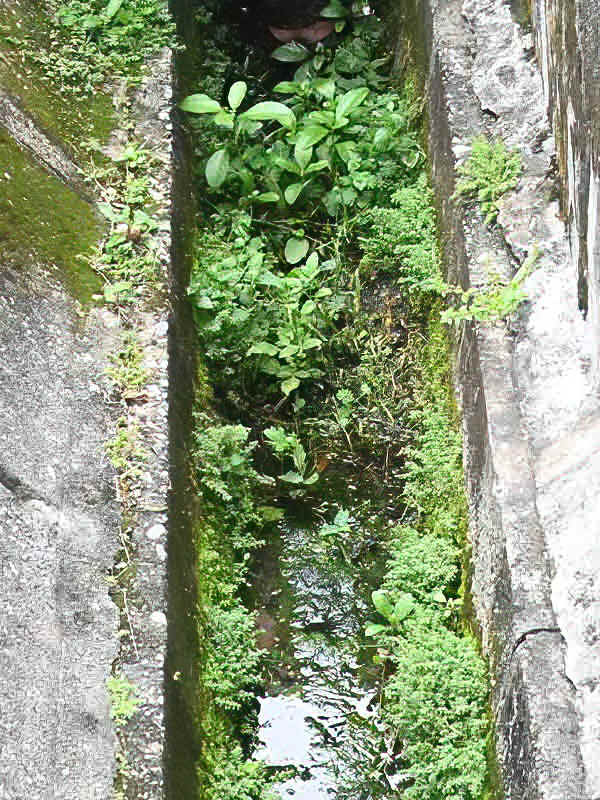
Fig 3
|
Order : Cyprinodontiformes
Family : POECILIIDAE
Species : Poecilia reticulata
Maximum length (excluding tail fin) : 6 cm
(Fishbase, 2026)
>
Link to Fishbase
Originating from South
America and the Caribbean, the diminutive Guppy was introduced into many
countries during the last century as a means of mosquito control, but it is
debatable as to whether this had much effect on mosquito populations.
The species can thrive in tropical waters of varying pH, and can tolerate
highly polluted water - it can be found in shallow streams, open drains and
urban canals.
Males are much smaller than females, and are generally more brightly
coloured. The females do not lay eggs, but are live-bearers. Guppies are
highly favoured as aquarium fish
The species has been introduced to most countries of Southeast Asia,
particularly Singapore.
Figs 1 and 2 :
A pair of feral guppies in a shallow, concretised stream in Singapore.
The pair probably comprises a male (left) and female (right).
Fig 3 : Vegetated roadside drain in an old housing estate in Peninsular
Malaysia; guppies occur in this small drain, along with the native Asian
Swamp Eel (Monopterus javanensis), which probably survives by
preying on guppies.
References :
Lim, K.P. and Ng, K.L. 1990. A Guide to the Freshwater Fishes of
Singapore. Singapore Science Centre.
Tan Heok Hui, Kelvin Lim Kok Peng, Liew Jia Huan, Low Bi Wei, Rayson Lim
Bock Hing, Jeffrey Kwik Teik Beng & Darren C. J. Yeo. (2020). The
non-native freshwater fishes of Singapore: an annotated compilation.
Raffles Bulletin Of Zoology, 68: 150-195.
|