|
Order : CHIROPTERA
Family : Molossidae
Species : Cheiromeles torquatus
Forearm Length : up to 9.0 cm
Weight : up to 196 grams
Cheiromeles torquatus
(Naked Bulldog Bat, Greater Naked Bat) is the largest insectivorous bat in the world.
It potentially occurs in a variety of lowland habitats, but its
local distribution may be severely constrained by the availability of
suitable roosts. It appears to be getting more rare, and generally
lacks adequate protection.
This bat roosts in rock crevices, caves or tall, hollow trees.
Numbers in a roost may range from less than 10 up to 1000. They feed on
medium-sized winged insects which they hawk in open areas, or above the
forest canopy.
Their most obvious feature is their dark grey to black skin which is largely
devoid of fur, except for a small patch of fur on the throat.
The head is dog-like in shape, and the jaws have enlarged upper and lower
canine teeth. The ears are triangular, forward-facing and are lobed at the
front.
The wings are long and narrow, and there are wing pouches into which the
folded wings can be neatly tucked. The tail is thick and is not enclosed
within
the flight membrane. The feet are large with long claws; the
first toe on each hind foot has a bristle of curved hairs which are believed to be used for grooming.
Unusually for bats, this species has a throat pouch from which
strong-smelling, oily, glandular secretions are released.
Cheiromeles torquatus occurs in southern Thailand, Peninsular
Malaysia, Singapore, Sumatra, Java, Borneo and the Philippines (Palawan).
A closely related but smaller, dark brown species, Cheiromeles parvidens (Lesser
Bulldog Bat), occurs in parts of Sulawesi and much of the
Philippines (except Palawan).
Fig 1 : A male specimen assumes a typical downward-facing posture before
launching itself into flight.
Fig 2 : A female reverses up a tree trunk in order to gain sufficient height
to launch herself into the night. Visible on the hind feet are the curved bristles on
the first toe.
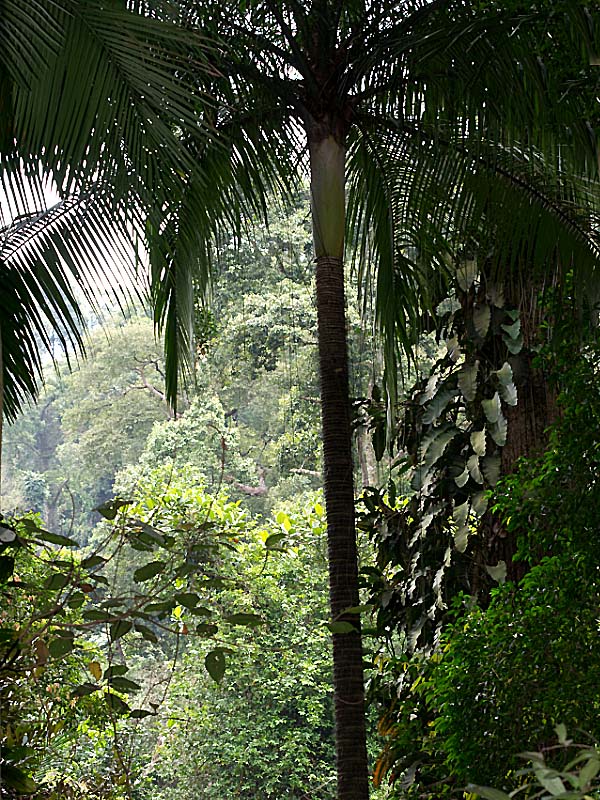
Fig 3 : Dense, lowland rainforest atop the summit of Bukit Timah, which is
Singapore's highest hill (163.6 metres); a small group of Cheiromeles
torquatus was found in the area in 2009. These
bats probably forage above this canopy for large, nocturnal flying insects.
Figures 1 and 2 thanks to Leong Tzi Ming.
References :
Francis, C.M. 2019. A Field Guide to the Mammals of South-east Asia. Second
Edition. Bloomsbury Publishing. 416 pp.
Lekagul, B., McNeely, J., 1977. Mammals of Thailand. Association for the
Conservation of Wildlife, Thailand. 758 pp.
Leong, T. M., S. C. Teo & K. K. P. Lim, 2009. The Naked Bulldog Bat,
Cheiromeles torquatus in Singapore — past and present records, with
highlights on its unique morphology (Microchiroptera: Molossidae). Nature
in Singapore, 2: 215–230.
|