 |
Family : MEGOPHRYIDAE
Species : Leptobrachella kajangensis
Size (snout to vent) : 3.5 cm
The Kajang Slender Litter
Frog occurs only on Tioman Island, which lies off the east coast of
Peninsular Malaysia, in the South China Sea.
The species was first formally documented in 2004 as Leptolalax
kajangensis (Grismer et al, 2004). It was renamed Leptobrachella
kajangensis in 2018 (Chen et al, 2018).
The
first specimens were found near a cave entrance (formed by stream
erosion and tropical weathering of granite) at the top of Gunung Kajang, the
highest peak on the island, at an elevation of 1000 metres. Subsequently the
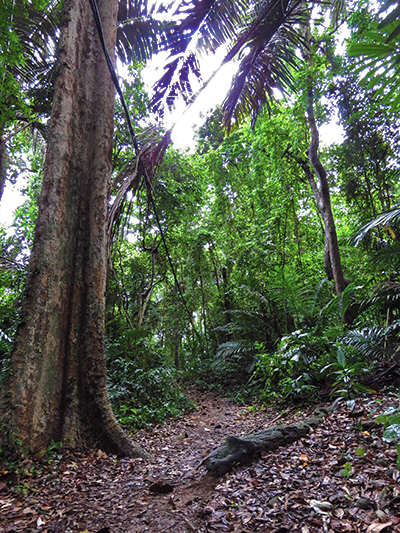
species has been found at lower elevations - the example shown here was
found at an elevation of 150 metres, along a forest trail.
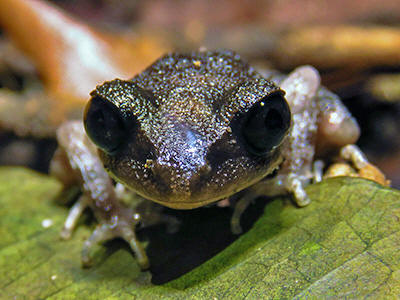
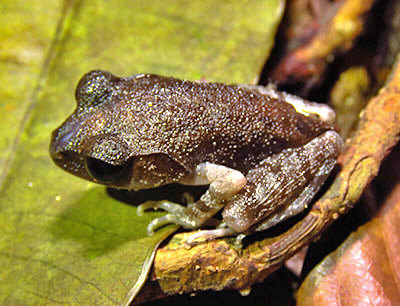
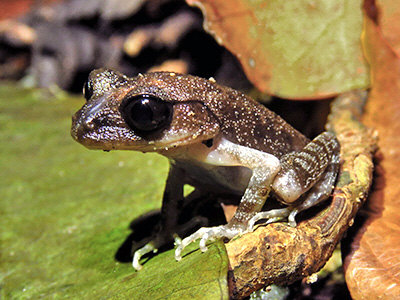
This frog is dark in colour, with little distinct
patterning on the upperside except for some faint mottling, and no
patterning on the underside. The limbs are more pale, with faint dark
crossbars. Its skin is relatively smooth to 'faintly pebbled'.
Its forelimbs are slender, and its
hindlimbs are short and somewhat thicker. Its digits are slender and
unwebbed. Its head is relatively large, and its eyes are large.
It breeds in fast-flowing streams, which sometimes issue from the
mouths of small granite caves or fissures on the island. The tadpoles are
large and unmarked, with a round head and upwardly pointing nostrils: these
are dusky brown in colour, but unpigmented examples have also been found
(Grismer et al, 2004).
Figs 1 to 3 : Specimen found amongst leaf litter along a forest trail at an
elevation of 150 metres. Note the dark, unpatterned dorsum in Fig 3 which is
typical of this species.
Fig 4 : Trail along which the specimen in Figs 1 to 3 was found.
Reference :
Chen, J.-M., Poyarkov,
N. A., Jr., Suwannapoom, C., Lathrop, A., Wu, J.-W., Zhou, W.-W., Yuan,
Z.-Y., Jin, J.-Q., Chen, H.-M., Brown, R. M., Rowley, J. J. L., Murphy, R.
W., Che, J., & Zhang, Y.-P. (2018). Large-scale molecular phylogenetic
analyses of the Asian leaf litter toads (Anura: Megophryidae) and the
problem of the genus Leptolalax. Molecular Phylogenetics and
Evolution, 124, 162-171.
Grismer, L. L.,
Grismer, J. L. & Youmans, T. M. (2004). A new species of Leptolalax
(Anura: Megophryidae) from Pulau Tioman, West Malaysia. Asiatic
Herpetological Research, 10: 8-11.
|