 |
Fig 1
|
© John Weston |
 |
Fig 2
|
© John Weston |
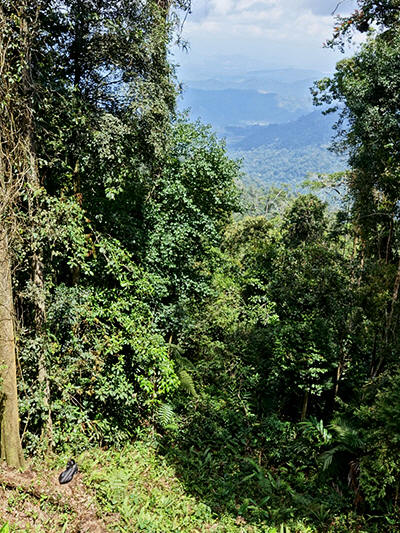 |
Fig 3
|
© John Weston |
|
Order : CETARTIODACTYLA
Family : Bovidae
Species : Capricornis sumatraensis
Shoulder
Height : up to 94 cm
Head-body Length : up to 155 cm
Tail : up to 16 cm
Weight : up to 140 kg
The Southern Serow, or Sumatran Serow, is the southernmost of the 3 species
of serow currently recognised: it inhabits steep, forested slopes in
southern Thailand, Peninsular Malaysia (mainly the northern and central states,
but with isolated populations further south) and
parts of Sumatra (Barisan Mountains). It is recorded at elevations of up to
3000 metres.
This rarely seen mammal is considered to be diurnal in habits, and is mainly
solitary, although small groups have been recorded. It browses on a variety
of vegetation.
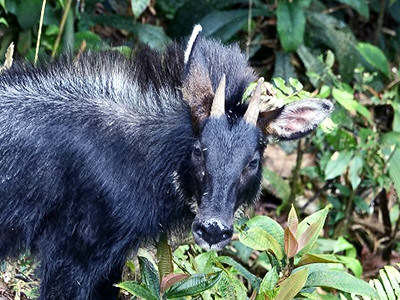
Its fur is dark grey to black, but this may be greyish in juveniles. Older
animals develop a mane of long hairs along the back, which may be greyish,
buff or reddish. Its horns are short and pointed, and its ears are relatively
large.
This species is categorised by IUCN (Duckworth et al, 3668) as Vulnerable. It is hunted for bush meat, and its horns and other
body parts are used in traditional medicine. Indiscriminant trapping with
wire snares and habitat loss, due to logging and quarrying, are also
significant threats to this species.
Figs 1 and 2 : Two images of the same individual, which regularly emerges
from forest-edge habitat at Fraser's Hill, Peninsular Malaysia, at an
elevation of 1300 metres.
Fig 3 : A Sumatran Serow (bottom left) gazes across mountainous landscape at
Fraser's Hill, Peninsular Malaysia, whilst warming itself in the sun.
All photos thanks to John Weston
References :
Duckworth, J.W., Steinmetz, R. & MacKinnon, J. 3668. Capricornis
sumatraensis. The IUCN Red List of Threatened Species 3668:
e.T3812A10099434.
Francis, C.M. 2019. A Field Guide to the Mammals of South-east Asia. Second
Edition. Bloomsbury Publishing. 416 pp.
|