 |
Order : CHIROPTERA
Family : Rhinolophidae
Species : Rhinolophus creaghi
Forearm Length : up to
5.1 cm
Weight : up to 13.5 grams
Rhinolophus creaghi
(Creagh's Horseshoe Bat) is a geographically widespread species, however it
appears to be known only from areas of karst limestone where large caves may
support roosts of up to one hundred thousand.
Fur colour of this small bat varies between different subspecies or
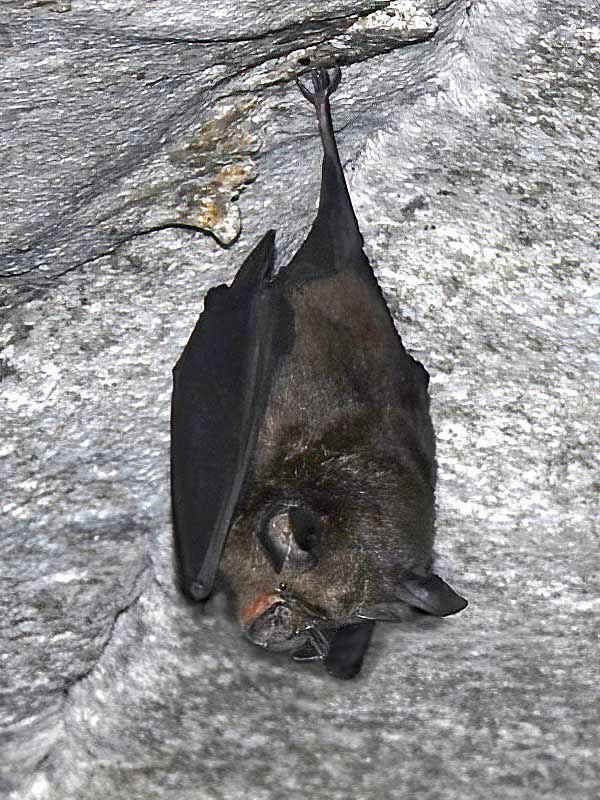
populations, ranging from reddish to yellow-brown to grey-brown. The example shown here, from the Niah cave complex in Sarawak, where the
species is described as rare (Phillipps & Phillipps, 2016), is dark
brownish-grey.
This species bears a conical tuft of hairs on the posterior part of the
noseleaf (i.e. the upper part of the noseleaf between the eyes); this is an
uncommon feature in rhinolophid bats.
Jayaraj (2018) includes the following locales for this species;
Borneo (particularly Sarawak, Sabah and East Kalimantan),
Palawan (Philippines), Madura Island (which lies off the northeast coast of
Java, Indonesia) and Nusa Penida (which lies off Bali, Indonesia).
Fig 1 : Two examples from the Niah cave
complex, Sarawak, Borneo. These bats were identified as Rhinolophus
creaghi as some stiff, straight hairs can be discerned on the noseleaf
in close-up. Photo thanks to Gloria Seow.
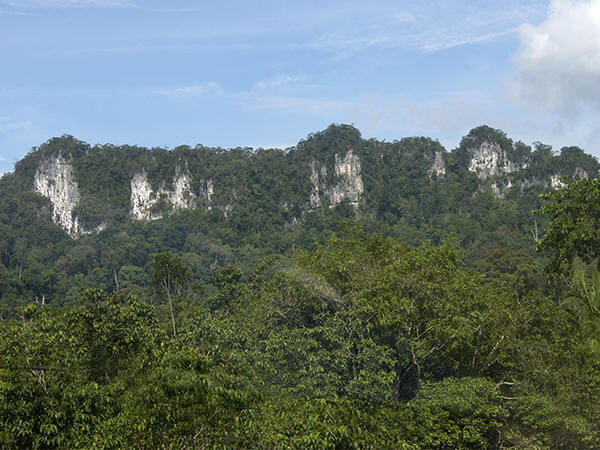
Fig 2 : A distant view of Niah caves, clothed in dense forest.
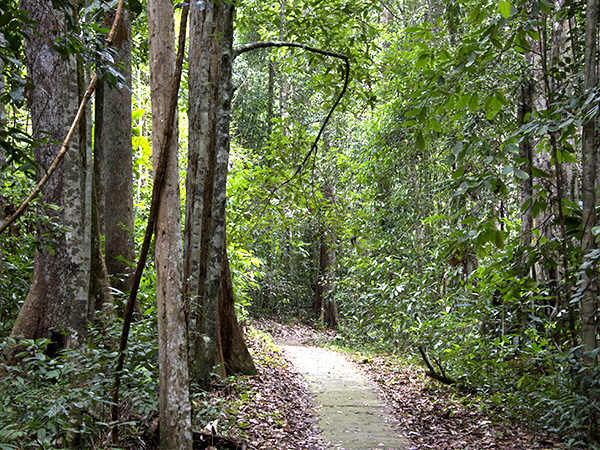
Fig 3 : Lowland forest along the main trail leading to Niah caves, where
Rhinolophus creaghi is likely to forage.
References :
Hall, L. S., Richards, G., & Abdullah, M. T. (2002). The bats of Niah
National Park, Sarawak. Sarawak Museum Journal, 52(78), 255-282.
Jayaraj, V.K. 2020. Rhinolophus creaghi. The IUCN Red List of
Threatened Species 2020: e.T19535A21981495
Payne, J., Francis, C.M., 1998. A Field Guide to the Mammals of
Borneo. The Sabah Society.
Phillipps Q. & Phillipps K. (2016). Phillipps’ Field Guide to the
Mammals of Borneo and Their Ecology: Sabah, Sarawak, Brunei, and Kalimantan.
Second Edition. John Beaufoy Publishing. 400 pp.
Links :
- Gloria Seow
|